
Archives
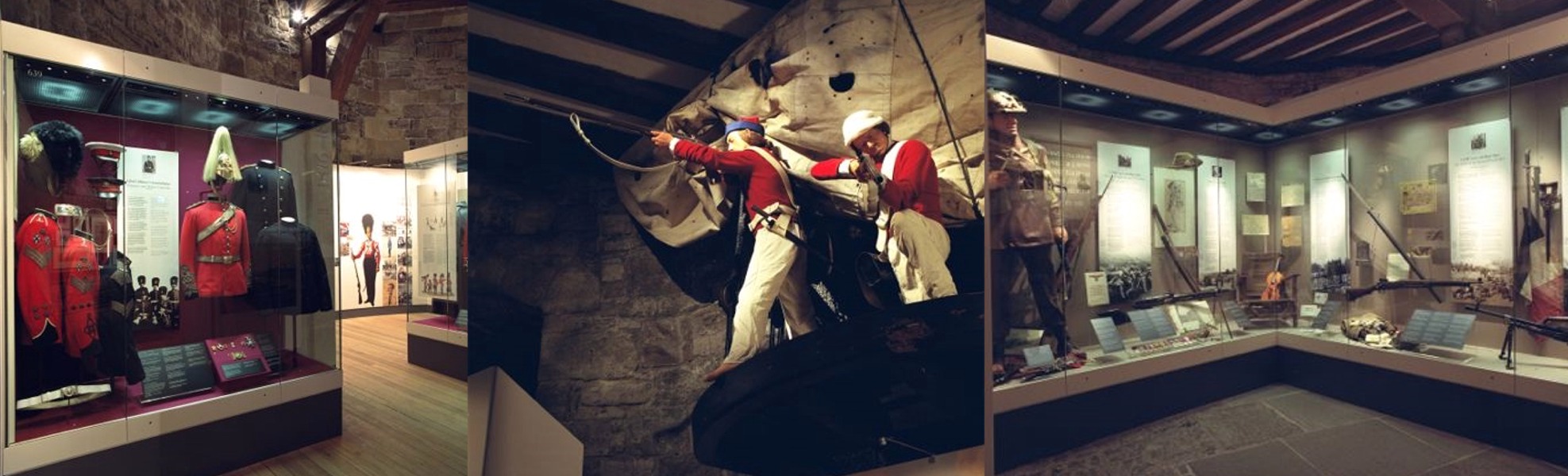
The Museum has thousands of stories to tell - from the experiences of an individual soldier to the history of an entire battalion. Many of the objects on display have a hidden history linking them to a soldier, places and events. It is not possible to explore all these stories within the Museum where space is limited.
The Regiment's reserve collection and archive is now held on behalf of the Museum Trust by Wrexham Museum. Wrexham was the home of the regimental deport at Hightown Barracks where generations of Royal Welchmen were trained from 1873 to 1960.
With such a large reserve collection and archive we will seek to post articles on individual soldiers or aspects of the Regiment’s long and distinguished history on this page. We encourage the submission of articles for this archive page from experts and enthusiasts alike. If you would like to contribute a short article about an object on display or an aspect of Royal Welch history, please contact the Museum with articles at contact@rwfmuseum.wales
United Services Journal 1832-3 The Earliest Published History of The Royal Welch Fusiliers - click here
Information coming soon...
With Cornwallis to the Dan: Deconstructing the “Forbes Champagné Letter”
By Gregory J. W. Urwin
Originally Published in the Journal of the American Revolution
The American War of Independence produced many dramatic episodes, but none sur-passed the campaign that Lt. Gen. Charles, Second Earl Cornwallis, conducted in North Carolina during the first three months of 1781 for hair-raising suspense and heartbreak. Things got off to a bad start for the British on January 17, 1781, at the Battle of Cowpens in western South Carolina. There Brig. Gen. Daniel Morgan with a mixed force of eight-een hundred to twenty-four hundred Continentals and militia smashed eleven hundred British and Loyalist regulars under the earl’s most flamboyant subordinate, Lt. Col. Banastre Tarleton. Determined to redeem the reputation of British arms and recover the six hundred prisoners Tarleton had lost, Cornwallis tried to prevent Morgan from rendezvousing with the main Continental army in the South under Maj. Gen. Nathanael Greene.[1]
Morgan gave his pursuer the slip, but Cornwallis remained determined to realize his original strategic vision. He would invade North Carolina and destroy Greene, which would secure the British hold on South Carolina once and for all, and also leave the Tar Heel State at his mercy. Although Cowpens had reduced the earl’s enlisted strength to 2,440, more than 2,150 of those men were seasoned regulars and widely considered su-perior to any number of troops Greene might put into the field. As James Lovell, a Mas-sachusetts delegate to the Continental Congress in Philadelphia, confided to a Boston friend about affairs in the South: “Our Army there is no match for Cornwallis, and if he pushes Suddenly he will ruin Genl. Green.”[2]
A sudden and sustained push was exactly what Cornwallis had in mind. While the earl waited for the rain-swollen Catawba River to subside, he rested and reorganized his ar-my at Ramsour’s Mill, North Carolina. The Cowpens defeat had deprived him of most of his light infantry, but he opted to increase the mobility of his entire army by drastically reducing its baggage train. “Great part of the wheel Carriages of the Army were dis-troy’d,” Lt. Harry Calvert of the 23rd Regiment of Foot (Royal Welch Fusiliers) scribbled in his diary on January 26. “Ld. Cornwallis set the Example by destroying all but one of his own Waggons.” The only other wagons that survived the conflagration were those reserved for hospital stores, ammunition, and salt, plus four to carry sick or wounded soldiers. Henceforth, Cornwallis’s men would have to forage for their rations and camp without tents. According to one of the earl’s more senior officers, those prospects did not daunt them: “In this situation without Baggage, necessaries, or Provisions of any sort for Officer or Soldier, in the most barren inhospitable unhealthy part of North America, opposed to the most savage, inveterate perfidious cruel Enemy, with zeal and with Bayonets only, it was resolv’d to follow Green’s Army, to the end of the World.”[3]
In the early hours of February 1, 1781, Cornwallis marched his army in two columns to-ward the Catawba River to kick off what history remembers as the “Race to the Dan.”[4] The next six weeks would irrevocably change the nature of the struggle for the South and arguably determine the outcome of the Revolutionary War.
One of the earliest eyewitness accounts of Cornwallis’s North Carolina campaign to reach British readers appeared in the Leeds Intelligencer on June 26, 1781. The news-paper attributed that chronicle to an officer in one of Cornwallis’s most reliable units: “Extract of a letter from Capt C. of the 23d Regiment, now serving under Lord Cornwal-lis, to his relation Lieutenant C. on the recruiting service at Doncaster, dated Wilming-ton, April 17, 1781.” The lines that followed must have thrilled and stirred the pride of their original audience:
I Embrace this opportunity which the ship that brings his Lordship’s dispatches affords me to inform you that I am well, tho’ greatly fatigued, and to congratulate you upon the success of his Majesty’s arms, and the conquest of the Southern Colonies: We have been constantly victorious, tho’ excessively harassed, owing to the nature of the country and the manoeuvres of the rebels. On the evening of the 31st of March, it was resolved to cross a ford called Stuart’s ford, which we were informed the rebels had overlooked in the panic our rapid movements occasioned among them. The first column consisting of the guards, grenadiers, &c. arrived at the place early on the first, but found the river swelled by the heavy rains, and guarded by a few irregular militia, who cowardly firing upon us during our passing the ford, which was nearly 700 yards wide. Notwithstanding this interruption, the whole column advanced upon them, with Gen O’Hara at its head; and had not the affair been rather serious, by the opposition of the skulking rebels, you would have been highly entertained with the situation and behaviour of our gallant leader. You know he is a little man, and consequently unfit to march thro’ a deep river: he was therefore obliged to ride upon the back of one of the grenadiers of our regiment, with his double barrelled fusee in his hand: Being by this circumstance a good mark for the rascals, they fired several shots at him, which he took no notice of ‘till he got within forty yards, when he returned the fire off his grenadier, and had the good fortune to strike three of the wretches and wound a fourth, upon which the rest fled to the woods with the greatest precipitation. The officers laughed at the droll adventure, and compli-mented the General upon his victory. The whole detachment landed immediately, and marched thro’ a close and boggy country, ‘till it joined the main army, to seek the enemy. The country people received us with the most unfeigned tokens of joy, as their deliverers from the oppressive, iron-hand of the rebel Congress; and great numbers daily joined the Royal standard. Unfortunately 300 of our friends, from excess of loyalty, venturing to march to us through the rebel quarters, were every man scalped, and their leader Col. Pyle, hanged up by the heels. But this unparalleled cruelty serves only to make our friends more steady and zealous in assisting us to restore their former legal and consti-tutional government. Nothing but light skirmishes happened ‘till we got up to the enemy on the night of the 14th, which next day brought on the attack and brilliant victory at Guildford, when the rebels were totally routed, and all their cannon, baggage and camp-equipage taken by our gallant victorious troops. Their force when they engaged consist-ed of eight continental regiments, and the rest militia, amounting in the whole to 10,000 men. Ours was about 3,800. The rebels left 500 dead upon the field, and upwards of 900 wounded, most of them must die for want of Surgeons and necessaries. Mr. Green col-lected the scattered remains of his followers and retreated (plundering all the way) into Virginia, where he was put under arrest by order of Congress. Thus the two fruitful provinces of North and South Carolina are entirely free from the oppressions of the re-bels, and restored to the King’s peace. Our victorious army is at present in the neigh-bourhood of Wilmington, from whence we are soon to march to join Brigadier General Arnold, in order to subdue the strong and valuable province of Virginia.[5]
This letter was discovered several years ago, and it has been cited by several scholars. Students of the Revolutionary War will instantly recognize that it casts new light on such memorable incidents as Cornwallis’s crossing of the Catawba, the notorious “Pyle Massacre,” and the Battle of Guilford Courthouse. The original transcriber of this ex-cerpt attributed it to Forbes Champagné, the only captain serving with the 23rd Foot at the time whose surname began with a “C.”[6] A close examination, however, reveals that this narrative contains so many errors, exaggerations and inconsistencies so as to call into question not only its accuracy, but also its authorship.
Born in Ireland in 1755 to a family of Huguenot descent, Forbes Champagné entered the British Army by purchasing an ensign’s commission in the 4th Regiment of Foot on May 29, 1773. He saw action with his regiment at Lexington, Massachusetts, on the first day of the Revolutionary War, April 19, 1775. Champagné purchased his lieutenancy on Jan-uary 26, 1776, and received an assignment to the 4th Foot’s light infantry company. Dur-ing the American War, British infantry regiments normally detached their grenadier and light infantry companies, which were grouped with others of their type in elite pro-visional battalions. Consequently, Lieutenant Champagné fought with the 1st Battalion of Light Infantry in the New York campaign of 1776, the Philadelphia campaign of 1777, and the Battle of Monmouth in 1778. Champagné purchased his way into the 23rd Foot as a captain and gained command of one of the regiment’s eight battalion companies on April 24, 1779. Captain Champagné sailed south with the Royal Welch Fusiliers in De-cember 1779 to participate in Gen. Sir Henry Clinton’s successful siege of Charleston, South Carolina. The 23rd remained in the South and Champagné became its acting commander that summer after a fever killed his major. The young captain led his fellow fusiliers in an irresistible bayonet charge that helped clinch Lord Cornwallis’s devastat-ing victory over Maj. Gen. Horatio Gates’ larger Rebel army at Camden, South Carolina, on August 16, 1780.[7]
Forbes Champagné also had a brother in the British Army, who could have been the “re-lation” mentioned by the Leeds Intelligencer. Josiah Champagné was two years older than Forbes, and he did not become a soldier until two years later, obtaining an ensign-cy in the 31st Regiment of Foot on January 28, 1775. The 31st Foot did not embark for North America until nearly a year after the outbreak of hostilities, and it arrived at Quebec in late May 1776. Promotion to lieutenant and a five-year appointment as regi-mental adjutant came on June 1, 1777. Except for the 31st Foot’s grenadier and light in-fantry companies, which marched south to Saratoga with Lt. Gen. John Burgoyne, Josi-ah’s regiment spent the war in Canada. Josiah’s obituary revealed that he “remained on active service till the peace, when he returned to England.” To put it another way, regi-ments did not send their adjutants home on recruiting duty. The “Lieutenant C.” on re-cruiting service in Doncaster had to be somebody else.[8]
As for the letter excerpt showcased in the Intelligencer, it opened with a spirited descrip-tion of Cornwallis’s crossing of the Catawba River, although it got both the date and lo-cation of that operation wrong. Lord Cornwallis approached the Catawba in the early morning hours of February 1, 1781, not April Fool’s Day.[9] The earl knew that North Carolina militiamen under Brig. Gen. William Lee Davidson guarded the most likely crossing places along the river’s opposite bank. He ordered Lt. Col. James Webster to take a smaller part of the British troops to Beattie’s Ford, where Davidson had reported-ly stationed five hundred militia, to create a diversion. Cornwallis himself led the rest of his army to Cowan’s Ford, which was supposedly watched by a considerably slighter number of Rebels, for his “real attempt.”[10]
Cornwallis’s column included the Brigade of Guards under Brig. Gen. Charles O’Hara – two battalions of three companies each with personnel drafted from the three regiments of Foot Guards (1st, Coldstream, and 3rd). The Hessian Regiment von Bose followed in the Guardsmen’s tracks, along with the Royal Welch Fusiliers, two hundred cavalry from Tarleton’s British Legion, and two three-pound guns. Unlike the typical line infan-try regiment, the Guards retained their light infantry and grenadier companies, and those formations spearheaded Cornwallis’s advance.[11]
The Redcoats groped their way through wooded terrain, their progress hampered by the early morning darkness and heavy rain. A three-pounder preceding the 23rd Regiment in the line of march overturned in a swamp. Cornwallis left the fusiliers behind to help ex-tricate the field piece from the mire, while he proceeded to Cowan’s Ford with the Guards and Hessians. Thus Forbes Champagné would not be in a position witness many of the scenes described in the document under analysis in this article.[12]
Plunging into a raging torrent waist deep or higher in many places, the Guardsmen came under heavy musketry from the left bank as they reached midstream. General Da-vidson and some three hundred militia had taken post at Cowan’s Ferry the night be-fore, but proved unable to check the Guards, who forged on without pausing to fire until they stumbled onto the opposite shore. Suffering the loss of one officer and three men killed and thirty-six men wounded, the brigade scattered its opponents and killed the valiant Davidson.[13]
One of the most vivid passages in the Leeds Intelligencer account depicted General O’Hara riding across the Catawba “upon the back of one of the grenadiers of our regi-ment.” Such a thing was possible because the river’s swift current caused O’Hara’s horse to roll over with its rider still in the saddle. It is entirely feasible that the drenched brig-adier could have made use of a grenadier to complete his crossing. After all, the British Army filled its grenadier companies with men chosen for their height and strength. The only problem is that the grenadier in question could not have belonged to the Royal Welch Fusiliers, which did not reach the river’s right bank until minutes after O’Hara disentangled himself from his stricken steed’s stirrups and reins. Indeed, the 23rd Foot’s grenadier company was not to be found anywhere in the Southern Theater at that time. As part of the 1st Battalion of Grenadiers, the 23rd’s company served through the Siege of Charleston from February to May 1780, embarking for New York on the last day of the latter month. Hence, the only British grenadiers present at Cowan’s Ford on February 1, 1781, belonged to the Brigade of Guards. Likewise, the officer quoted by the Leeds Intel-ligencer was probably not Forbes Champagné at all. References to Charles O’Hara as “our gallant leader” and “one of the grenadiers of our regiment” indicates that the au-thor of those words actually belonged to the Guards, especially since Captain Champa-gné probably never got close enough to witness O’Hara’s adventures.[14]
The description of Brigadier O’Hara downing four Rebels with a double-barreled fusil from the back of his human mount is quite striking, but it would have taken a miracle to make it happen. Any flintlock weapon doused in a river would have had its gunpowder ruined and could not be fired without having the sodden loads extricated, its barrels and locks dried, and new rounds rammed home. There is also the question of how O’Hara could have managed to extricate the weapon from his upturned steed as it flailed about in the roaring river.
Over the next two weeks, Cornwallis marched many of his men out of their shoes in a no-holds-barred effort to overtake and destroy Greene’s army. From February 13 to 15, the earl conducted a series of forced marches covering sixty-six miles in a final bid to pin Greene along the Dan River before the latter passed over that stream into Virginia. On the morning of the fifteenth, the British advance guard reached the south side of the Dan six hours after Greene’s rear guard had been rowed to the opposite shore. Exhibit-ing remarkable objectivity for someone two weeks short of his eighteenth birthday, Lieutenant Calvert pulled out his diary and penned this tribute to the two leading con-testants in the Race to the Dan: “No Army could have pursued another more closely than Ld. Cornwallis’s did Green’s & No General could have conducted his Army better that Genl. Green did his; he had a great advantage in being in a friend’s country without it he could never escaped Ld. Cornwallis’s great Activity.”[15]
Not feeling strong enough to follow Greene into Virginia, Cornwallis retired by easy stages to Hillsborough, North Carolina, where he raised the royal standard and issued a proclamation inviting “all loyal Subjects to repair to it, and to stand forth and take an Active part in assisting me to restore Order and Constitutional Government.” The re-sponse to this summons left the earl feeling bitterly disappointed. “The principal reasons for undertaking the Winter’s Campaign,” he confessed, “were, the difficulty of a Defen-sive War in South Carolina, and the hopes that our Friends in North Carolina, who were said to be very numerous, would make good their promises of assembling & taking an Active part with us in endeavouring to re-establish His Majesty’s Government. Our ex-perience has shewn that their numbers are not so great as has been represented, and that their friendship was only passive.” Brigadier General O’Hara confirmed his com-mander’s words in a letter addressed to a noble patron in England: “The novelty of a Camp in the back Woods of America, more than any other cause, brought several People to stare at us, their curiosity once satisfied, they returned to their Homes.” Lieutenant Colonel Tarleton also claimed that few North Carolinians were willing to take up arms for the king. This testimony contradicts the rosy picture presented in the Leeds Intelli-gencer, which asserted that residents of the Hillsborough area greeted Cornwallis’s troops with “the most unfeigned tokens of joy.”[16]
To be fair to North Carolina’s Loyalists, it bears remembering that they had been living under the thumbs of their Rebel neighbors for nearly six years, and some had suffered severe persecution. As a Quaker resident of the state told Charles Stedman, Cornwallis’s American-born commissary, a few weeks later: “It was the general wish of the people to be reunited to Britain; but that they had been so often deceived in promises of support, and the British had so often relinquished posts, that the people were now afraid to join the British army.”[17]
One indomitable Loyalist militia colonel, Dr. John Pyle, broke with the prevailing te-merity and called on his friends and neighbors residing between the Haw and Deep riv-ers to turn out under arms and follow him to Hillsborough. Somewhere between two hundred to four hundred rallied to him. Pyle had informed Cornwallis of his plans, and the earl sent Lieutenant Colonel Tarleton to cross the Haw on February 24 with two hundred light dragoons from the British Legion, one hundred and fifty British infan-trymen, and one hundred jägers to effect a rendezvous. As fate would have it, Nathanael Greene had ordered Lee’s Legion and two companies of Maryland Continental infantry under Lt. Col. Henry Lee back across the Dan to prevent North Carolina Loyalists from rising. On February 25, Lee sighted Pyle’s column. Mistaking the similarly clad Conti-nental light dragoons for Tarleton’s men, the relieved Loyalists held their fire. At the request of one of Lee’s officers, they even moved to one side of the road to permit their supposed friends to pass. When the two forces were roughly parallel, Lee’s troopers wheeled their horses, drew their swords, and fell on the surprised Loyalists with a vengeance. Ignoring repeated cries for mercy, the Rebels kept hacking at their prey until they had killed at least ninety and wounded most of the rest.
It would seem impossible to exaggerate an incident as horrific as the Pyle Massacre, but the Leeds Intelligencer account does so. Rebel sabers no doubt inflicted many disfigur-ing wounds, but no other sources charge Lee’s men with taking scalps. As for Colonel Pyle being “hanged up by the heels,” he did suffer several wounds, but still managed to escape with his life. Finally, the fate of Pyle’s force further intimidated North Carolina Loyalists rather than inflaming them. [18]
Once Greene swelled his ranks with sufficient reinforcements, he returned to North Carolina seeking battle. He and Cornwallis clashed at Guilford Courthouse on March 15, 1781. As related in the Leeds Intelligencer, the British drove Greene’s numerically supe-rior Continentals and militia from the field, taking four six-pound guns. Cornwallis claimed that he had beaten more than 7,000 Rebel regulars and militia, although his intelligence had led him to believe that he would face 8,000 to 10,000 foes. In reality, Greene fielded in excess of 4,000 men, and Cornwallis met him with 1,924 officers and men. The earl lost 506 dead or wounded and 26 missing, which made Guilford Court-house the perfect definition of a pyrrhic victory.[19]
Seeking to save face, Cornwallis labeled Guilford Courthouse a “Signal Success” and “compleat victory.” Three days afterward, he distributed another proclamation inviting loyal North Carolinians to stand with his army and promised clemency to Rebels who surrendered themselves, along with their arms and ammunition, to him or any other British official. These empty words fooled no one, least of all Cornwallis himself. As he admitted in a private letter to a brother general: “The idea of our Friends rising in any number & to any Purpose totally failed as I expected.”[20]
Cornwallis withdrew his crippled army to Wilmington to refit and seek better care for his wounded. Greene took advantage of his adversary’s predicament to march south to attack vulnerable British outposts in South Carolina. Cornwallis deemed an overland pursuit of Greene far too risky with his drastically diminished ranks. He decided that his best chance of drawing Greene north was to strike at the Quaker general’s main source of supplies: Virginia. Far from leaving the Carolinas “entirely free from the oppressions of the rebels, and restored to the King’s peace,” the earl had opened the door to both of them being restored to the control of the young United States. Congress did not place Nathanael Greene under arrest for his defeat at Guilford Courthouse, but permitted him to extinguish British authority in all of South Carolina except for Charleston and its environs.[21]
Aside from deconstructing the account of Cornwallis’s 1781 North Carolina campaign from the June 26, 1781, edition of the Leeds Intelligencer, what has this exercise achieved? It seems highly unlikely that Forbes Champagné or any other officer of the Royal Welch Fusiliers penned this narrative. Could it be a fraud – a burst of braggadocio concocted by a patriotic editor or some other writer to boost morale on the British home front? Capt. Henry Broderick, Cornwallis’s aide-de-camp, arrived at London on June 4, 1781, with the two dispatches that the earl had composed on March 17 covering his campaign from Cowpens to Guilford Courthouse, and they appeared in the London Gazette the very same day. That would have afforded some ingenious scribe in Leeds the sources and plenty of time to fashion a jingoistic variation and attribute it to one of the earl’s officers. Such circumstances could account for the many departures from fact that teem in that brief chronicle.[22]
On the other hand, actual eyewitnesses have been known to spread unintentional or de-liberate falsehoods. Portions of this story ring true, offering statements that were, at the very least, plausible. Judging from the internal evidence, “Capt C.” most probably be-longed to the Brigade of Guards. Independent scholar Linnea Bass discovered that the brigade possessed an officer who might have been “Capt C.” Napier Christie ranked as a lieutenant in the 3rd Regiment of Foot Guards, but as a captain in the British Army at large, in keeping with the dual rank structure that applied to Guards officers. The Amer-ican-born Christie was posted to the brigade’s grenadier company on November 6, 1780, which would have placed him in General O’Hara’s proximity at Cowan’s Ford three months later.[23]
Judging from the spin “Capt C.” put on Cornwallis’s failed campaign, he either suffered from unrealistic optimism, or he was too diplomatic to cast a highly connected senior officer’s endeavors in a negative light. Just how an officer of the 23rd Regiment of Foot ended up getting credited with authoring this piece remains a mystery.
Acknowledgments
Research for this article was funded in large part by an Earhart Foundation Fellowship from the William L. Clements Library at the University of Michigan, a Tyree-Lamb Fel-lowship from the Society of the Cincinnati, a Mellon Research Fellowship from the Vir-ginia Historical Society, a research fellowship from the Richard H. Smith International Center for Jefferson Studies, and two Summer Research Awards from Temple Universi-ty.
[1] Lord Charles Cornwallis to Sir Henry Clinton, January 18, 1781, No. 1, PRO 30/11/5/43-46, Charles Cornwallis Papers, National Archives, Kew, United Kingdom; Cornwallis to Lord George Germain, March 17, 1781, No. 7, 150:1, Sir Henry Clinton Pa-pers, William L. Clements Library, Ann Arbor, Michigan. For the best account of Cowpens, see Lawrence E. Babits, A Devil of a Whipping: The Battle of Cowpens (Chapel Hill: University of North Carolina Press, 1998).
[2] Cornwallis to Clinton, June 30, 1780, Clinton Papers, 107:27; Cornwallis to Clinton, August 6, 1780, 115: 39; Cornwallis to Clinton, August 10, 1780, 116: 17; Cornwallis to Germain, March 17, 1781, No. 7, 150:3, all in Clinton Papers; “State of the Troops That Marched with the Army under the Command of Lieut General Earl Cornwallis,” n.d., PRO 30/11/5/134, Cornwallis Papers; Banastre Tarleton, A History of the Campaign of 1780 and 1781, in the Southern Provinces of North America (London: T. Cadell, 1787), 209; James Lovell to Samuel Holten, February 8, 1781, No. 835, Sol Feinstone Collec-tion of the American Revolution, ca 1760s-1850s, American Philosophical Society, Phil-adelphia, Pennsylvania.
[3] Charles Stedman, The History of the Origin, Progress, and Termination of the American War, 2 vols. (Dublin: P. Wogan, P. Byrne, J. Moore, and W. Jones, 1794), 2: 362-63; Cornwallis to Germain, March 17, 1781, No. 7; Harry Calvert, “Gen. Sir H. Cal-vert, August 16 1780 to October 19 1781,” January 24-26, 1781, (9/102/1), Claydon House Trust, Middle Claydon, Buckingham, United Kingdom. Hereafter cited as Calvert, “Dia-ry.” Charles O’Hara to August Henry Fitzroy, Third Duke of Grafton, April 20, 1781, in George C. Rogers, Jr., ed., “Letters of Charles O’Hara to the Duke of Grafton, South Car-olina Historical Magazine 65 (July 1964): 174.
[4] Cornwallis to Germain, March 17, 1781, No. 7.
[5] Leeds Intelligencer, June 26, 1781.
[6] See “Letter: from Captain Forbes Champagne, 23rd Regiment of Foot, while on Cam-paign in the Southern Colonies, to His Brother in England,” Documentary History of the Battle of Camden, 16 August 1780, http://www.battleofcamden.org/champayne.htm (accessed June 21, 2016), and Lawrence E. Babits and Joshua B. Howard, Long, Obsti-nate, and Bloody: The Battle for Guilford Courthouse (Chapel Hill: University of North Carolina Press, 2009), 39.
[7] J. A. Houlding, “British Army Officers Database, 1725-1793” (unpublished manu-script in Houlding’s possession, 2016); Mark Urban, Fusiliers: The Saga of a British Redcoat Regiment in the American Revolution (New York: Walker and Company, 2007), 201-3; “Succession of Colonels of the Seventieth Foot,” in Richard Cannon, Historical Record of the Seventieth, or the Surrey Regiment of Foot (London: Parker, Furnival, & Parker, 1849), 18-19. Cornwallis to Clinton, August 23, 1780, 118: 18, and Thomas George Barrette to Clinton, August 26, 1780, 118:41, both in Clinton Papers.
[8] Houlding, “British Army Officers Database”; Don Troiani and James L. Kochan, In-signia of Independence: Military Buttons, Accoutrement Plates, & Gorgets of the Ameri-can Revolution (Gettysburg, PA: Thomas Publications, 2012), 88; “Obituary.—Gen. Sir Josiah Champagne, G.C.H.,” Gentleman’s Magazine, May 1840, 542.
[9] Lt. Harry Calvert of the Royal Welch Fusiliers, who faithfully kept a diary during Cornwallis’s operations in the Carolinas and Virginia from August 16, 1780, to October 19, 1781, did not record the British conducting an opposed river crossing on April 1, 1781. Nor did the three most important British memoirists of Cornwallis’s Southern cam-paigns, Lt. Col. Banastre Tarleton of the British Legion, Sgt. Roger Lamb of the Royal Welch Fusiliers, and Charles Stedman, the earl’s commissary.
[10] Cornwallis to Germain, March 17, 1781, No. 7.
[11] Cornwallis to Germain, March 17, 1781, No. 7; Stedman, American War, 2: 224; Babits and Howard, Long, Obstinate, and Bloody, 91, 92.
[12] Cornwallis to Germain, March 17, 1781, No. 7; Calvert, “Diary,” February 1, 1781.
[13] Cornwallis to Germain, March 17, 1781, No. 7; Henry Lee, Memoirs of the War in the Southern Department of the United States, ed. Robert E. Lee (New York: University Publishing Company, 1869), 233-34; Calvert, “Diary,” February 1, 1781; John Buchanan, The Road to Guilford Courthouse: The American Revolution in the Carolinas (New York: John Wiley and Sons, 1997), 344-48.
[14] Stedman, American War, 2: 365; Cornwallis to Germain, March 17, 1781, No. 7; Roger Lamb, An Original and Authentic Journal of Occurrences during the Late Ameri-can War, from Its Commencement to the Year 1783 (Dublin: Wilkinson & Courtney, 1809), 343-45; “Officers Roster 1st Battn. Grenadiers Dec, 22d. 79,” in George Philip Hooke, “Orderly Book, 17th Grs.,” Orderly Book Collection, 1764-1815, Clements Library. See also Hoke’s entries for December 20, 1779, and February 11, 1780; John Peebles, John Peebles’ American War: The Diary of a Scottish Grenadier, 1776-1782, ed. Ira D. Gruber (Mechanicsburg, PA: Stackpole Books, 1998), 313, 338, 376, 382, 396, 445, 480.
[15] Calvert, “Diary,” February 2-15, 1781; Buchanan, Road to Guilford Courthouse, 348-58.
[16] Cornwallis to Germain, March 17, 1781, No. 7; Cornwallis to Germain, April 18, 1781, No. 10, 152: 41, Clinton Papers; Calvert, “Diary,” February 18-25, 1781; O’Hara to Grafton, April 20, 1781; Tarleton, Southern Campaigns, 231.
[17] Stedman, American War, 2: 286-88; Tarleton, Southern Campaigns, 231.
[18] Cornwallis to Germain, March 17, 1781, No. 7; Calvert, “Diary,” February 24-25, 1781; Tarleton, Southern Campaigns, 231-33; Stedman, American War, 2: 371-72; Lee, Memoirs, 253-59. The best reconstruction of the Pyle Massacre is Jim Piecuch, “’Light Horse Harry’ Lee and Pyle’s Massacre,” Journal of the American Revolution, June 19, 2013, https://allthingsliberty.com/2013/06/light-horse-harry-lee-and-pyles-massacre/#_edn23 (accessed June 25, 2016).
[19] Cornwallis to Germain, March 17, 1781, No. 7; Cornwallis to Germain, March 17, 1781, No. 8, 150: 4; J. Despard, “Field Return of the Troops under the Command of Lieu-tenant General Earl Cornwallis in the Action at Guilford, 15th. March 1781,” n.d., 149: 32; J. Despard, “Return of the Killed, Wounded and Missing of the Troops under the Com-mand of Lieut Genl. Earl Cornwallis in the Action at Guilford, 15th March 1781,” n.d., 149: 30; J. Despard, “Return of the Killed & Wounded on the March through North Car-olina in the Various Actions Preceding the Battle of Guilford,” n.d., 149: 33, all in Clin-ton Papers; Babits and Howard, Long Obstinate, and Bloody, 77, 80-94.
[20] Cornwallis, Proclamation, March 18, 1781, PRO 30/11/101/28, and Cornwallis to William Phillips, April 10, 1781, PRO 30/11/85/31-32, both in Cornwallis Papers; Corn-wallis to Germain, No. 8, March 17, 1781.
[21] Cornwallis to Phillips, April 10, 1781; Cornwallis to Phillips, April 24, 1781, PRO 30/11/76/57-58, Cornwallis Papers; Cornwallis to Germain, April 18, 1781, No. 9, 152: 40; Cornwallis to Germain, April 18, 1781, No. 10, 152: 41; Cornwallis to Clinton, April 24, 1781, 156: 18; Cornwallis to Clinton, May 26, 1781, 158: 16, all in Clinton Papers.
[22] London Gazette, June 4, 1781.
[23] Linnea Bass, “Dec 1780: Brigade of Guards Restructured,” n.d., attached to Linnea Bass, e-mail to the author, June 27, 2016; Houlding, “British Army Officers Database.”
Journal of The Brigade of the American Revolution - Winter 2011 - click here
Jenny Jones a Regimental Wife
 Jenny Jones of Tal y Llyn, Meirionnydd was at Waterloo with her first husband, Pte Lewis Griffiths of the 23rd Regiment (Royal Welch Fusiliers). In 1876 an account of her life, as told by Jenny herself, was published in the “Cambrian News”. Although some of the things she related are difficult to reconcile with known facts, the account gives a vivid and honest picture of the life of a soldier’s wife in the early nineteenth century. The following is an attempt at reconstructing Jenny’s early life.
Jenny (or Jane) Jones was born in Ireland, probably in 1797, her maiden name being Drumble. Her home town was most likely Granard in County Longford.
Jenny met her first husband, Lewis Griffiths, in Ireland, where he was stationed with the Royal Merionethshire Militia. She was aged 14, the daughter of a farmer, and he was 19 (born in 1793). The couple were married, apparently against the wishes of Jenny’s family, and she never communicated with them again. No record of Jenny and Lewis’ marriage has so far been found (see Note 1).
Pte Lewis Griffiths
Lewis Griffiths was from Tal y Llyn, the son of Humphrey and Jane Griffiths of Pentre Dol y March, a group of small houses on the northern shore of the lake. Lewis was his mother’s maiden name.
The Militia Acts required each County to raise a certain quota of men to serve in its Militia Regiment for defence of that County. In time of war the Militia regiments could be embodied to serve outside their County boundary. An Amendment Act of 1799 increased the Militia Quota for Merionethshire to 226 men.
Following the Declaration of War by Britain on Revolutionary France in May1803 the Merionethshire Militia (A Royal Regiment from April 1804) was embodied for garrison duty. It served in Southern England until June 1811 when it was transported from Devon to Ireland. It was stationed in Granard, County Longford. In August strength of the Regiment was 135 men, organised into two Companies. Lewis Griffiths appears on the 1811 Muster Roll of the Royal Merionethshire Militia preserved in the National Archives at Kew.
Many Militia men volunteered to serve with the “regular” Line Regiments. Among them was Lewis Griffiths who joined the 23rd Regiment (Royal Welch Fusiliers) in 1814. Griffiths entry on the Waterloo Medal Roll states that he was “with the Corps” from 5th April 1814. His attestation describes him as a labourer, aged 19. He was also a married man. Lewis Griffiths served with No. 7 Company of the 23rd, under Captain Thomas Farmer.
Lewis Griffiths was typical of the soldiers in the 23rd of 1815 in that he had come from an agricultural background. Only 30% of the men were Welsh however. Most of the English counties were represented in the ranks and 10% were Irish (as was usual in all the British Line Regiments). Lewis Griffiths was one of 76
private soldiers who had joined the 23rd since the Peace in 1814. The majority of the private soldiers were aged 20 or less. However, compared to other regiments at Waterloo the 23rd was an experienced unit as many had seen service in Spain or Southern France.
The 23rd Regiment was pulled in to Wellington’s army in Europe, marching against the reinstated Emperor Napoleon. It belatedly joined an extra Brigade, the 4th British Brigade under Lt Col H H Mitchell. It formed part of the 4th Division, commanded by Lieutenant General Sir Charles Colville.
The 23rd Regiment at Waterloo 18th June 1815
The 23rd Regiment left Gosport on the 23rd March 1815 and landed at Ostend on the 30th March. Jenny accompanied her husband on the Waterloo campaign, presumably on the strength of the Regiment, acting as nurse/cook/laundrymaid. She may by then have had a child - some accounts give her a daughter.
(see Note 2). The Regiment was moved by canal boat to Ghent, via Bruges. It was reviewed by Wellington, with the rest of the Brigade, at Oudenarde, on 20th April. From there it marched to cantonments at Grammont on 24th April. It stayed there until 16th June. It then marched to Braine-le-Leud, arriving on the 17th and passed the night in torrential rain.
Wellington placed the bulk of his strength, including Mitchell’s Brigade, to the right of his line. This was fortunate for the 23rd Regiment as it suffered less casualties than those in the centre and on the left. Even so it lost four officers and eleven men killed, and eight officers and seventy-eight men wounded.
Early on the morning of 18th June 1815 the 23rd took up its position, in the second line, to the left of the Nivelles Road. In front of it was a battalion of the Guards. It deployed into line and the men were told to lay down as they were quickly under fire from French artillery on the road. The cannon fire killed the Commanding Officer of Lewis Griffith’s Company, Captain Thomas Farmer, and may have given Lewis his wounds, which were in the shoulder and, according to the story, were from cannon shot.
The 23rd moved into the front line to replace the Guards battalion, withdrawn to give support at Hougoumont. It formed a square and remained in that formation all day, facing many attacks by French cavalry. The Commanding Officer of the 23rd, Colonel Sir Henry Ellis commanded that no man should break rank, even to help a wounded comrade. The Regiment did not falter, even though the artillery fire continued, and every attack upon it failed with heavy casualties. The square retired to its former position, then advanced again and the 23rd finished the day by advancing in line and finding nothing to oppose it.
During the afternoon, however, Colonel Ellis was struck in the chest by a musket ball. He remained in command until, faint from loss of blood, he was forced to ride to the rear. Weakened, he fell from his horse. He was found and taken to a farmhouse where his wound was dressed. He died the following day, aged 32.
After Waterloo
After the battle Jenny searched for Lewis and eventually found him in a Brussels hospital – the Elizabeth. Presumably she was still with him when the 23rd marched to Paris and, on the 4th July, encamped in the Bois de Boulogne.
Lewis Griffiths was discharged from the Regiment on 6th April 1821. He received no pension and his Waterloo Medal was stolen. Lewis and Jenny returned to Tal y Llyn to live in a house named Cildydd. They had several children - possibly six. Lewis Griffiths worked in the slate quarries at Corris, to which he would walk over the hills from home. Lewis was killed in 1837 in Aberllefeni Quarry, aged 45 (his year of birth must have been 1792 or 1793). He was buried in an unmarked grave in Tal y Llyn churchyard.
Jenny began working in the laundry of one of the hotels on Tal y Llyn. For a time she may have been a school teacher at Maes y Pandy.
After a few years of widowhood, Jenny married John Jones of Y Powis, Tal y Llyn on June 1st 1853. Jones too was widowed. Both gave their address as Cildydd, and both signed the register with an X (strange if Jenny was a school teacher!). Jenny gave her maiden name as Drumble. It was not a happy union as Jones was a lazy man, and instead of easing it, the marriage increased Jenny’s poverty. After John Jones’ death Jenny went to live at Pant-y-dwr and later at Tyn yr Ywen, Tal y Llyn, where she died on April 11th 1884, aged 94. She was more likely 87 (see Note 3).
Jenny was buried in Tal y Llyn parish churchyard on April 15th 1884. Her final resting place is marked by a rather fine gravestone, far beyond what she could ever have aspired too. Its inscription forms the final mystery regarding Jenny Jones. It reads:
“I will never leave you nor forsake thee
This cross was placed here by a friend.
Sacred to the memory of Jenny Jones
Born in Scotland 1784
She was with her husband of the 23rd Royal Welch Fusiliers at the battle of Waterloo and was on the field three days.”
Brian R Owen
RWF Museum
2010
Note 1:
The Army distrusted the presence of women and always tried to discourage soldiers from marrying. From 1685 marriage was allowed only with the CO’s permission. The number of married soldiers was restricted to 6% of strength – usually six wives per company. This was the “official” number but the system was abused and there were many more unofficial wives and women in barracks. The situation of a wife on the strength was highly insecure particularly when the unit was sent abroad.
Note 2:
Only 4 or 6 wives per Company were allowed on campaign, and were selected by ballot. Great distress was caused among the wives who were left and they often ended up in Parish poorhouses or on the street.
Note 3:
In both the 1841 and 1851 Census Jenny gave her birthplace as Ireland. In the 1851 Census she gave her age as 54 and this is most likely correct.
The Admiral's Sword and the IMPERIAL EAGLE - Peter A. Crocker
 This sword is the 1803 infantry officers' pattern etched for the Royal Welch Fusiliers (late 23rd Regiment of Foot) with a grenade, the Prince of Wales's feathers, and 'XXIII'. It was presented to the Regiment in1956 by Mrs Rosalie Cockburn in whose family it had been since 1809.
In January of that year the British attacked Martinique, a base for French activity in the West Indies. The naval blockade having failed, the naval and military commanders on the spot decided on an expedition to capture the island.
The 1st Battalion The Royal Welch Fusiliers landed with the Fusilier Brigade on 30th January. At about the same time Captain George Cockburn RN put ashore a strong naval detachment which, with army help, established a battery of guns to bombard Fort Bourbon, the last French stronghold on the island.
On 1st February the French were driven from Morne Bruno to the heights of Sourier. The Royal Welch led, by the 'Grenadier' Company ascended the heights where the contest was "most obstinate, with the French repeatedly returning to the attack with drums beating. The Grenadiers, however, maintained their ground. The remainder of the battalion now came up and a sharp action took place which terminated in the retreat of the French " who were eventually forced back into Fort Bourbon.
The fort was subjected to a devastating bombardment by the artillery on the 2nd, including Cockburn's naval guns, and the garrison soon surrendered.
£850 was voted to the wounded in Martinique by Lloyds of London, no less than £250 of which was allocated to the Grenadier Company of the Royal Welch.
Captain Cockburn, who signed the articles of capitulation, was awarded the rank of Major General of Marines, with no duties but £2,000 a year. Because of the close contact between Cockburn and the Royal Welch during the action he acquired a Royal Welch sword as a souvenir of a great occasion. By the time of his death in 1853 he was an Admiral of the Fleet and had inherited the family baronetcy.
The Royal Welch were awarded 'MARTINIQUE, 1809' as a Battle Honour which to this day is borne on the Regimental Colour. Furthermore, the Napoleonic Eagle standard-the French equivalent of British 'Colours'-of the 82nd Regiment of Infantry, which was captured at Martinique, was presented to the Regiment.
Both the Admiral's sword and the 'Eagle' standard may be seen displayed in the Museum. I am indebted to Major EL Kirby for his notes on the history of the sword.
The Keys of Corrunna - Peter A. Crocker
In 1808 the war with Napoleonic France was reaching its peak. The 2nd Battalion The Royal Welch Fusiliers sailed from Falmouth in Cornwall with 671 officers and men, forty-eight wives and twenty children for Corunna in Spain, which they reached on 13th October. They were to reinforce the army of Sir John Moore and to assist in driving the French out of Spain.
Just before Christmas, Moore learnt that he was about to be trapped by Napoleon, with an army twice as strong, Moore decided to retreat over the mountains to Corunna. It was a desperate march through thick snow with a shortage of food and boots. The men, still accompanied by the wives and children, were generally bare-footed. Their sufferings were made worse by a violent storm during the night of 8th January. Discipline in the army broke down and there was much pillage and drunkenness. It is a great credit to the 2nd Battalion that by the time they reached Corunna on the 11th only seventy-eight men had been lost.
The battle of Corunna began at 2 p.m. on the 16th. Just as the French advance had been checked Moore was fatally wounded. At 10 p.m. the troops began to embark and by the following morning only the two brigades which had covered the embarkation remained on shore. They embarked on the night of the 17th/18th and the 2nd Battalion The Royal Welch Fusiliers was the last to leave this portion of Spanish soil.
The following account was written some years later by Miss Fletcher, a descendent of one of the officers present on that day:
"The rear-guard was commanded by Captain Thomas Lloyd Fletcher, of the Royal Welch Fusiliers. He, with his corporal, were the last to leave the town. On their way to embark, and as they passed through the gates, Captain Fletcher turned and locked them. The key not turning easily, they thrust in a bayonet, and between them managed it. Captain Fletcher brought away the keys, and they are now in the possession of his son ....
The keys are held together by a ring, from which is suspended a steel plate, with the inscription 'Postigo de Puerta de Abajo' ('Postern of lower gate'). One key still shows the wrench of the bayonet."
Thomas Fletcher transferred to the 4th Ceylon Rifles in 1810. He retired as a Lieutenant Colonel in 1846 and lived at Maesgwaelog, Overton, and Gwern Haulod, Ellesmer, where he brought up his five sons and seven daughters. He died in 1850.
The keys were presented to the Museum by H Lloyd Fletcher in 1955.
EGYPT 1801
 This year marks the bicentenary of the Egyptian Campaign of the Napoleonic Wars. The Sphinx has now become synonymous with many Regiments of the British Army displayed as Regimental badges to commemorate each Regiment’s participation in the campaign. For the Royal Welch Fusiliers the Sphinx is displayed on the Regimental Colour and has been adopted as one of the five company emblems now associated with Delta Company within the Regiment. It is not clear when these company emblems were originally allocated to specific companies of the Regiment but the Sphinx has been associated with Delta Company for many years.
The Egyptian Campaign was conducted over the period February to October 1801. The British force was mustered by the 30 December 1800 under General Abercromby in Marmorice Bay, Turkey, some forty miles north of the island of Rhodes. The aim was to invade Egypt and drive out Napoleon’s force of occupation. The Regiment’s strength at the start of the campaign was 28 officers, 486 other ranks fit for duty, 54 sick and 57 absent! The expedition did not leave Marmorice Bay until the 22 February 1801 and so valuable time was spent practising landings and manoeuvres on land. The 23rd formed part of the British reserve under Major-General John Moore. The Regiment landed on the 8th March from the Astrea and Heroine on beaches close to the port of Alexandria having rowed 6 miles from their ships, the last leg being under severe cannonade and grape shot. Having made it to the beach the force advanced with regiments forming up in front of what Abercromby described as an “almost inaccessible” hill. In fact it was a massive sand dune which the 23rd were given the responsibility of capturing along with the four flank companies of the 1st and 2nd Battalions of the 40th Regiment. The troops rushed up the dune with:
“almost supernatural energy, never firing a shot but charging with the bayonet two [French] battalions which crowned it, breaking them and pursuing till they carried the two Nole [sic] hills in the rear, which commanded the plain to the left, taking at the same time three pieces of cannon.”
The remainder of the heights were cleared within two hours and the 23rd earned the commendation of Major-General Moore. The Regiment’s casualties for the action were six other ranks killed with two officers (Captains Lloyd and Pearson) and 38 other ranks wounded. Also listed as wounded by some accounts was Captain Ellis, a remarkable officer who went on to command the Regiment at the battle of Waterloo 14 years later.
On the 12th March the British force moved off across deep sand to confront the rest of the French Army who were defending another high feature called Roman Camp some four miles forward of Alexandria. The British attacked on the 13th March with the 23rd continued to form part of the reserve. In this attack the reserve assumed the right hand column of three parallel advances. The French gave up the high ground to attack the other two British columns and by doing so allowed the reserve to turn their exposed flank and seize the high ground of Roman Camp. The day’s casualties for the Regiment were two killed and four wounded. Abercromby consolidated the ground he had taken and waited for a French counter attack which was launched against the hill on the 21st March. The French attacked at dawn but as Captain John Hill of the 23rd recalled, the large plumes of the French head dress were silhouetted against the rising sun giving away their attack. Hill wheeled his Company in silence to face the French, giving orders to fire when the French were 35 yards away. During a second volley Captain Bradford brought up his company on the right with Captain Ellis on his left. Once in position the order to charge was given, resulting in about three hundred and fifty French prisoners taken. The reserve again took the brunt of the fighting and the 23rd had 5 killed and 15 wounded which included Lieutenant Samuel Cooke. However, the most significant casualty of the battle was Sir Ralph Abercromby who later died of a wound sustained on that day. Following this action the 23rd Foot remained in the area of Alexandria under the command of Major General Coote to complete the capture of Alexandria whilst the majority of the force advanced on Cairo.
The British continued their operations throughout April, May and June with a series of successful engagements. The French finally evacuated Cairo on the 27th June 1801 and following further actions surrendered Alexandria on the 2nd September 1801 effectively capitulating all French forces in Egypt. At the end of the campaign the Regiment was able to raise a strength of 343 other ranks.
The Regiment were withdrawn from Egypt in October 1801 en route for Malta. There were 115 personnel recorded as sick present and 106 sick absent.
Egypt was the first battle honour granted in the Napoleonic Wars, it was in fact the first real victory of the war for the British. The fact that it was achieved so far from home, in the relative distances of this period also made it a remarkable feat of arms. Some of those who served in the campaign were lucky enough to be honoured with decorations from Sultan Selim III of Egypt or by the East India Company if they were members of the Company’s private army. Incredibly, the British Government did not honour those who had served in the campaign until 1848 when the Military General Service Medal was issued. Not surprisingly many of those who had served had either been killed in the later campaigns of the Napoleonic Wars or died of natural causes.
The Sphinx superscribed Egypt was awarded as a battle honour on the 6th July 1802 to all 33 Regiments who served in the Egypt campaign. Of these 22 adopted the Sphinx in some form or other as part of their dress. Early versions of this badge showed the Sphinx on top of a plinth in which hieroglyphics were inscribed as shown above. This was later changed, by moving the word Egypt into the plinth to replace the hieroglyphics. It is not clear when the sphinx was actually placed on the Colours of the Regiment but the Sphinx subscripted the word Egypt was present on the King’s colour and just the Sphinx on the Regimental colour by 1807. By 1820 Sphinx had been removed from the King’s/Queen’s Colour and is was present on the Regimental Colour with a scroll above inscribe Egypt and a green laurel wreath below the Sphinx. It is this design which can still be seen on the Regimental Colour today.
Two hundred years after the event, this remarkably successful campaign carried out far from home in the most harsh of climates is commemorated by the Regiment on the Regimental Colour and by the company emblem of Delta Company.
NJL
A REAL LIFE RICHARD SHARPE LIEUTENANT COLONEL JOHN HILL OF THE 23RD FOOT
By Major Nick Lock RWF
In November 1999 a small seaside town in Holland unveiled a new memorial to commemorate all those who had drowned in a shipwreck off their coast some two hundred years ago. The ship was the Dutch frigate Valk which sank in November 1799. A total of 446 lost their lives, of these, 235 were officers and men from the 23rd Foot. A vivid account of this tragedy, given by Lieutenant (later Lieutenant Colonel) J.H.E. Hill appears in Volume I of Regimental Records of The Royal Welch Fusiliers and in the booklet, Letters to a Vicarage 1796-1815. This enterprising young officer was one of only 25 survivors of the ship wreck, cheating death by strapping himself to the detached ship’s forecastle using only his pocket handkerchief and his braces!
Reading about this extraordinary adventure prompted me to find out more about the life of John Humphrey Edward Hill. The story that emerges is a real life adventure, which is every bit as worthy of a series of novels to rival Bernard Cornwell’s Richard Sharpe character.
John Hill was born the son of the Reverend J. Hill of Hennock, Chudleigh, Devon. He was commissioned into the 23rd Regiment on the 29th July 1796 and joined the 1st Battalion on its return from the West Indies in October 1796. He was posted to the Lieutenant Colonel’s Company (a full Colonel commanded the battalion at this time) and took part in the disastrous expedition to Ostend in March 1798. Hill, eleven other officers and 192 other ranks from the 23rd Foot, were captured by the French and imprisoned in the citadel of Lille until their release a year later.
His next period of active service came in 1799 when he took part in a raid on the North Dutch coast, with the 1st Battalion. A sharp action was fought by the 23rd who were the first ashore. The battalion lost 18 killed and 77 wounded. A total of seven Dutch vessels were captured and it was whilst sailing home in the captured Dutch frigate ‘Valk’ that the now infamous shipwreck occurred.
Having survived life as a prisoner of war and a shipwreck, Hill was to be involved in a number of operations on the coasts of France and at Ferrol and Cadiz during the year 1800 (perhaps a comparison to the Hornblower character can be drawn here!). He subsequently went on to command a company of the Regiment during the Egyptian campaign of 1801 against the French. The Regiment was involved in a number of battles, most notably, the assault on two French Battalions which held the massive sand dunes of Aboukir Bay. Following victory in Egypt, the Regiment undertook a period of garrison duties in Gibraltar in 1802. Hill was promoted Captain in 1803 and was granted a spot of home leave.
In 1805 and 1806 Hill was engaged in operations in the Hanover area of Germany and in 1807 at the siege of Copenhagen, Denmark. It was here that he was wounded for the first time; he was bayoneted by one of his own men! An over enthusiastic member of the night piquet mistook him for the enemy during an alert, stabbing him in his right side. A period of three weeks of bed-rest followed before he was fit again.
Following his service in Europe, Captain Hill left for Halifax, Nova Scotia and then Barbados, West Indies, in 1808. The following year he commanded the Light Company at the capture of the heights of Sourier and the siege and capture of Martinique. During this period, the West Indies was an extremely unhealthy place to serve. Indeed, during a previous period of service from 1794 to 1796 the Regiment had 12 officers and 600 other ranks succumb to tropical disease, lead and alcohol poisoning! Luckily this period of service was mercifully short and the Battalion returned to Halifax in 1809.
In 1810 Hill sailed for Portugal with the 1st Battalion to take part in Wellington’s Peninsular campaign, during which he was present at nearly all the major battles including: Ciudad Rodrigo, Albuera, Badajoz, Salamanca, Madrid and Vittoria. At the storming of San Sebastian he was wounded when a grape shot (small cannon ball) passed between his left arm and side. During this time he spent periods in command of the 1st Battalion and of a number Portuguese regiments. He was commanding the 4th Portuguese Regiment at the battle of Nivelle when his horse collapsed on top of him. He required two surgical operations to repair the injuries sustained in this incident. The letters he wrote home during this period show just how bloody many of these battles were. The life expectancy of an officer at this time, especially when storming fortifications, was not high. Hill’s letters also show how important the prospects of promotion were in increasing an individual’s social standing. This was especially true if an officer did not, like Hill, have the funds to purchase his next promotion.
After returning to Britain for a short period, Hill embarked in March 1815 with the rest of the 1st Battalion following Napoleon’s escape from Elba. The battalion was present at the Battle of Waterloo and during the course of the battle Hill was severely wounded. Fighting on foot, in the front line of the square, he was wounded no fewer than five times. He received a splinter of bone (which came from another soldier) driven into his right eyeball and two fragments of stone shrapnel in his cheek. If this was not enough, he also received a musket ball wound to the left side of his jaw and finally, for good measure, a half-pound grape-shot punched through his left breast and shoulder blade, lodging in the back of his jacket!
Miraculously, he survived and made a slow and painful recovery. In a letter to his brother following the battle, he describes in graphic detail how, in the days before anaesthetic surgery and antibiotics, his own wounds were starting to heal. He also, with great distress, describes the terrible injuries sustained by his treasured horse ‘Honesty’ before it died. Following Waterloo he transferred to the 49th Foot (later the Hertfordshire Regiment) as a Major in 1823. One can only presume that he found life in the 23rd Foot a little too exciting! In December 1823 he rather understandably applied to retire on grounds of ill health, and was granted a pension of 300 pounds per year. He married a Miss Jane Turner and lived the rest of his life at Holt Hall, Totnes, Devon. He died in January 1835, aged 59.
This extraordinary career spanned 28 years. In his application to the King for the grant of a pension, Hill pointed out that when he left the 23rd Foot he was the longest serving member of the Regiment. During his service, he had been at every engagement fought by the 23rd Foot, which included 20 battles, seven sieges, one shipwreck and once set fire at sea!
Some 250 pages of transcripts of his letters home during his long career are held in the Regimental Museum, along with his numerous medals. Extracts from his letters where edited by his Great-Great-Great Granddaughter, Edith Case into a short booklet entitled Letters to a Vicarage 1796-1815.
Remarkably one of those present at the November 1999 memorial unveiling ceremony was on of Hill’s descendants Lieutenant Hill, seen in the photograph, a serving member of The Royal Welch Fusiliers.
Bibliography
Histories:
Cary, ADL & MaCance, S., Regimental Records of The Royal Welch Fusiliers (late 23rd Foot). Volume I, 1689-1815. (London, 1921). 324 p 8 cp 8 illus & numerous maps.
Broughton-Mainwaring, Maj. Rowland, Historical Record of the Royal Welch Fusiliers, late the Twenty-Third Regiment, or The Royal Welsh Fusiliers. (Hatchards: London, 1889). lviii 372 p, 24 colour plates, 8 illus.
Kirby, MC TD FMA DL, Maj E.L., & Holme, N., Medal Rolls of the 23rd The Royal Welch Fusiliers in the Napoleonic Period. (Spink & Son Ltd: London,1978). 206 p & 4 illus.
Glover, Michael, That Astonishing Infantry, Three Hundred Years of the History of The Royal Welch Fusiliers (23rd Regiment of Foot) 1689-1989. (Leo Cooper: London, 1989). 356 p 19 cp, 101 illus, 24 maps.
Kirby, MC TD FMA DL, Maj E.L., Officers of The Royal Welch Fusiliers 16 March 1689 to 4 August 1914. (Gwynedd Archives: Caernarfon, 1997). 138 p.
Biographies:
Browne, T.H., [Ed: RN Buckley], The Napoleonic War Journal of Capt Thomas Henry Browne, 1807-16. (Army Records Soc, Bodley Head: 1987). xix 387 p 1 cp 20 illus & 5 maps.
Hill, Lt Col J.H.E., [Ed: Jenny Currie], Letters to a Vicarage 1796-1815. (Oriel Press, 1988). 48 p 5 illus & 7 maps.
Thorpe, Maj Samual, Narrative of Incidents in the Early Military Life of the Late Maj Samual Thorpe KH, Secretary of the Foreign Aid Society. With Introduction and Appendix by Friends. (Seeleys: London, 1854). viii 100 p.
Archive Material In The Archive Of The Regimental Museum Of The Royal Welch Fusiliers:
Hill, Lt J.H.E., Notes by (later Lt Col) on original letter re-Loss of Dutch Frigate Valk 1816 and letters from his campaigning (1796-1816). L/d 37773171b.
 Captain Edward Hill pays his respects to his ancestor Captain Edward Hill pays his respects to his ancestor |
 Lt Col John (Jack) Hill Royal Welch Fusiliers Lt Col John (Jack) Hill Royal Welch Fusiliers |
“The Roll of the Drum” first appeared in the Regimental Journal - Y Ddraig Goch

It was many years ago-to be exact in September, 1892, that the Second Battalion The Royal Welch Fusiliers made their famous march through the Northern Counties of Wales, “enroute” from “the Curragh” to Aldershot, their newly appointed station.
The story of their march has been dealt with already by many an able writer, and since the present one did not grace this planet even in the last year of the 19th century, it is only with the assumption that the accompanying illustrations and newspaper cuttings may interest a few peo-ple, that the following article, if indeed these ungrammatical lines may be called by such a name, is submitted to our “Ddraig Gochian” scrutineer for his examination, and perchance publication amongst the great talent which appears in each issue of our Regimental Journal.
A letter to the Author, from a participator of this march, is also included amongst this gal-axy of information. When it is read, it will be appreciated that it is the “Finale” to an unsuccessful attempt of transferring a labour, and if the truth were known, a labour not of love, to another more qualified scribe. All the cuttings referred to, in this letter, are not reproduced since there are too many of them.
It appears that if it had been practicable the daily newspapers of that period would have their columns gaily coloured with illuminated “letterings” so as to enable them to record appropri-ately to the public the glories of this “Military Move”, and, when reading the accounts of the festiv-ities which the R.W.F. enjoyed during this sojourn in North Wales, it is difficult to imagine a more pleasant method of changing stations than is depicted by the journalist of the early nineties.
However, to-day, in the year nineteen hundred and thirty-four, even if the authorities countenanced such a thought for “moves”, and that the “Exchequer” allowed the families of this principality (those fortunate to have survived the past 20 years) to welcome a Battalion of Royal Welchman with their renowned Celtic hospitality, surely such a march would be marred by the modern method of progression? The hills and valleys of Snowdonia would be echoing with the clatter and screeching of some obnoxious “mechanical box”, the “thumping” of an overloaded mo-tor conveyance would be desecrating the majestic solitude of the “Llanberis Pass”, while instead of the scarlet tunic of the nineteenth century riveting the gaze of the country lad, the exhaust note of some fiendish motor bicycle would be attracting his attention. No, to-day all is changed, indeed there must be some individuals in the Regiment at this moment who will remember a march twixt Tidworth and Dorchester in 1930, -dust begrimmed despatch riders with aching wrists, blister-footed drivers of iron monsters, their feet more tender than the result of many miles of marching, and a liver shaker transport officer in possession of a vocabulary far more efficacious than any ob-stinate quadrupled could cause – presumably all these human creatures and their unattractive fol-lowing would accompany a “road move” to-day. Are there any people in existence who would en-joy it? And what is far more important, would the Welsh hospitality endure this modernization. The writer not being a cleric will leave the questions unanswered.
The route followed by the 23rd wandered through some of the finest scenery to be found in the British Isles, and many an historic town and village was dotted along its itinerary. Needless to say one of the first villages, through which the battalion passed, was Llanfair PG., sometimes known as Llanfairpwllgwyngyllgogerychwyrndrobwllllantysiliogogogoch, which when interpreted means: “The church of Saint Mary in the wood of white hazel near a rapid whirlpool and near St. Tysilio’s cave close to a red cave”.
This name is slightly long--true a glimpse of the obvious—but as is often the case in Wales, names of villages and houses are often of stupendous length, but in recompense have some pret-ty meanings, and perhaps, a legend tacked on to them as well, however, of this anon—the story wanders.
It was on September the 2nd, 1892, that the R.W.F. landed on the shores of Anglesey and started their journey South. But before continuing it is now the appropriate moment to produce the letter which has been alluded to previously as it deals with certain facts which seem to have occurred prior to the actual start of the march.

DEAR “__________”,
You must remember it is now 42 years since all these interesting things happened. I was only a boy aged 21 years—a second Lieutenant with sixteen months service, but I can well re-member every detail as if it all happened yesterday.
I think we will begin with the photograph first. As you will observe it was a pouring wet day, I can practically name all the officers, but as the photograph is taken at an angle it is impossible to identify the officers on the right flank of the colours, but the following I can practically swear to.
Lt.-Col. Blyth is standing in front just behind the goat, on the extreme right standing by himself in front of the officers, is Major R.B. Mainwaring. Why the junior Major, Major Arslett, is not standing in the similar position on the left is not clear to me.
The line of officers commencing from the left flank reads as follows.
Major H.J. Archdale, Lieut. and A/Adj. J.D. Crosbie, Lieut. R.S. Webber, 2/Lieut. Piggot, Cap-tain Mulford, 2/Lieut. R.E.P. Gabbett, Captain Bright-Smith, 2/Lieut. H. Rotherham (holding the Colour on the left), 2/Lieut. W. G. Braithwaite (holding the King’s Colour).
The remainder of the officers are so indistinct that I defy anybody to name them.
It must be remembered that not all the officers of the 2nd battalion at the moment were in North Wales, as we left behind at Curragh, I suppose as a rear guard the following officers:
Captain R.B. Firman, Lieut. A.B. Gough, Lieut. Sir Horace McMahon, Lieut. G.E. Rickman, 2/Lieut. R. Barnett-Barker.
My memory is absolutely sound, and you can rely upon it, that what I say is correct.
With regard to the march itself. How can I improve upon the details given in these cut-tings? But a few personal details might perhaps bring back to memory years of long ago, to those of us who are still alive and were serving in the 2nd Battalion at that time. I well remember the start from the Curragh in that early September morning, 1892, when we marched across the long grass to the Grand Stand Station, where we entrained for Dublin.
On arrival in Dublin the Quarter-master, Lieut. Hammond, of all persons, took it into his head to develop an epileptic fit, and I was told off to take charge of him, and convey him to hospi-tal. This “contre” upset my personal plans and very nearly caused me to miss the troop ship. How-ever, having left Hammond in the hospital I raced down to Queenstown by train, just in time to catch up the Battalion already embarked on H.M.S. Assistance (one of the best known local troop-ships of that day). It was blowing a gale of wind, and as I am not as a rule a particularly good sailor, at the beginning of a voyage, I suffered the agonies of the condemned! Especially as I was told off to be Orderly Officer for practically half the night.
My great companion of those days, Dickie Gabbet, came to my assistance, and took over the duties from me, which was a truly noble act.
The next morning we disembarked in sunshine at Holyhead on very empty stomachs, but the ladies of Anglesey promptly came to the rescue with a most sumptuous breakfast on the sta-tion platform, the forerunner of many such feasts, which we enjoyed amongst the hospitable people of North Wales, where we reckoned we enjoyed forty-five champagne luncheons and din-ners during the 25 days of the march which was pretty good going.
From here we crossed the Menai Straits and thence we marched via Bangor, Caernarvon, Pwllheli, Cricieth, Portmadoc, Harlech, Blaenau Festiniog, Bala, Corwen, Llangollen, Ruthin, Wrex-ham and then by train to Aldershot. It was a most enjoyable march in every way which can be im-agined, and the hospitality of our hosts knew no bounds. I remember on one occasion a Senior Officer, who shall be nameless, was so overcome with goodwill, that he attempted to light his cigar with the electric light globe in the smoking room. It is questionable whether the march justified its purpose, or the expense entailed, because it is a fact that from a recruiting point of view only one recruit was obtained at the time, and he bought himself out within three weeks.
I might mention that the following officers only, who took part in this march, are alive to-day: 2/Lieut. W.G. Braithwaite (now Brig.-Gen. retired), Lieut. J.D. Crosbie (now Brig.-Gen. re-tired), Lieut. Graham Rickman (now Major retired), Lieut. Pigott (now in the Army Service Corps), Capt. Bright Smith (now Colonel retired), and Capt. Firman (now Colonel retired).
If I have left anybody out, I humbly apologise, and they must forgive me. Much water had passed under the bridges during the last 42 years.
Yours very sincerely,
“_______________”.
Little time has been given the writer and readers will have to bear with these “news cut-tings” coming in quick succession, with the result that the “whole” will inevitably be very disjoint-ed, however there is no alternative but to continue in an endeavour to produce the most interest-ing ones that are now available so as to produce some past news of the 2nd Battalion since present news is lacking. They will start with one depicting the scene at Caernarvon in “ninety-two”.
The 2nd Battalion of the Royal Welch Fusiliers struck their tents in Bangor, at half past ten on Saturday morning, and the regiment amid ringing cheers of the inhabitants, to which the men heartily responded, set out on their journey to Caernarvon. In due time they reached the pictur-esquely situated park of Llanfair Hall, the seat of Captain J.G. Wynn-Griffith who, with his usual generosity, had invited them to partake of his hospitality…….the men turned into the park, when, after piling arms, they were served with sandwiches and beer (lemonade to the teetotallers), on the grass, the sergeants being regaled with similar fare in a large tent near at hand. Colonel Blyth and the superior officers of the Regiment, together with a number of ladies and gentlemen of the surrounding district were the guests of Captain Wynn-Griffith at the hall. After lunch, each man received a packet of tobacco. Soon afterwards a start was made for Caernarvon, the Regiment bidding farewell to Llanfair Hall and their host with a volley of cheers. A mile outside Caernarvon, under the avenue of beeches, the Regiment was halted, and after a few minutes rest, bayonets were fixed……
The battalion having reached Turf Square, marched down High Street, and reached the tower end of the Square by way of Castle Street.
Precisely at three o’clock the band of the Regiment playing “March of the men of Harlech” with stirring effect was seen right under the wall of the Castle.
Hoisted on the Eagle Tower was the Royal Standard floating majestically above the colours of the distinguished 23rd who filed into the square with fixed bayonets. They were preceded by Capt. and Adjutant J. Griffith, of the 4th R.W.F. The Volunteers then presented arms, after which the Regiment was formed into review order in front of the platform, gave a general salute and presented arms, the movement being splendidly executed.
The Lord Lieutenant then in a clear voice read the following address:
To Lieut. – Col. Blyth, the Officers and men of the 2nd Battalion of The Royal Welch Fusiliers.
We, the inhabitants of Caernarvonshire, desire to express our sense of the honour con-ferred upon our county by the visit of the 2/R.W.F., and we beg to offer the Regiment a most hearty welcome. We dwell with pride upon the long and illustrious history of the old 23rd and re-joice, that the same spirit pervades the Regiment to-day as animated those heroes who raised your corps to the proud position it now occupies in the estimation of your country-men, we are much gratified to have this opportunity of making the acquaintances of our Territorial Regiment, and trust that the friendly relations thus established between us may be productive of much sym-pathy and goodwill. May your march through North Wales prove a success in every way, and result in the thorough and permanent identification of your Regiment with the Northern Counties of the Principality.
(Sd.) J. GREAVES,
Her Majesty’s Lieutenant.
. . . . at 9.30 p.m., the band of the Regiment marched into the Castle Square, where it had been announced they would play the “Tattoo”. The Square itself, with the public buildings and places of business, was brilliantly illuminated during the evening, while the Square was crowded with 1,000’s of people, amongst whom were hundreds from the surrounding rural districts. Shortly before half-past nine a torchlight procession escorted the Regimental band into the Square. The “first tattoo” having been sounded, the eastern end of the Castle, abutting the Square was lit up, and with the simultaneous burning of variegated lights upon the battlements of the several towers, the effect was simply grand. . . . after a lull a highly successful piece was the display of a huge dragon upon the façade of the Granary Tower, representing the old arms of the Welch Fusiliers. . . . On Tuesday the weather was most unpropitious, and as a result the proceedings at the Cae Toppis were con-siderably marred. It had been arranged that an inspection of the Battalion should be made on the camping ground by General Julian Hall at eleven in the morning, and at that hour the several Com-panies were drawn up in line, the number on parade being some 480, the other 70 being on duties connected with the camp. The Officers on parade were Colonel Blyth, Major Mainwaring and Archdale, Captains Mulford, Walker, Phillips, Bright-Smith and Engleheart, Lieutenants Bancroft, Webber, McMahon, Throckmorton and Richards, 2nd Lieutenants Braithwaite, Gabbett, Rotterham, Piggot and Hay, Lieut. and Adjt. Crosbie, and Surgeon-Captain Gerrard.
Shortly after eleven o’clock General Hall, who was accompanied by Colonel Creek, Asst. Adjt. General for the North Western District, who was preceded by Colonel Blyth in the command of the Battalion; Colonel Cooper, R.A.A.D.C.; Colonel Davies Cooke, 3rd Volunteer Battalion, R.W.F.; Colonel The Marquis of Anglesey, 3rd Volunteer Battalion, R.W.F., and Major Charles H. Rees, rode into the parade ground and was received with a general salute.
The General rode down the lines, and then, owing to the steady downpour of rain and the fact that the men were already drenched, the Battalion was considerately dismissed to their tents, and the inspection abandoned. . . .
* * * * * *
It appears that the 23rd remained at Caernarvon from Saturday, September 3rd to Wednesday, September 8th, during which period they do not seem to have been allowed “to idle”, what with Church parades on Sunday, the wet “General’s” Inspection on Tuesday, and to say nothing of the trip to Llanberis on the following Monday, where the famous Welsh Slate Quarries were viewed.
Before leaving Caernarvon for good, it is imperative that something must be said about its his-tory; there are doubtless many in the Regiment who will remember the Castles which overlook the River Rhine, however, Caernarvon Castle is infinitely superior to any one of them. To-day from the exterior Caernarvon Castle appears completed, and it is not until the main entrance is passed that the ruin of its interior is noticed. It was within these walls that the first English “Prince of Wales” was born. Everyone will remember how the chieftain of Wales asked for an overlord who might speak neither French nor English, and how these hardy Celts were tricked by King Edward. All this happened at Caernarvon within the very Square in which the Royal Welch paraded in 1892. To pass on after Caernarvon the next resting place was Pwllheli, which is on the North Western shores of Cardigan Bay, the receptions the Battalion was receiving were unbelievable, had the Royal Welch been returning from a victorious campaign in which they had achieved great distinction, the hospi-tality shown them could not have been augmented. From Pwllheli they proceeded on to Portmadoc, and from the latter town to Cricieth, once destined for the Brighton of North Wales, however ambition in this direction has now vanished, and to-day it is only the summer habitation of the “White Wizard!” who now in declining years appears no friend of soldiers. Nevertheless, as the following cutting depicts, in 1892 Cricieth in their turn accepts the 23rd with unbounded hospi-tality.
* * * * * *
WELSH FUSILIERS IN NORTH WALES

. . . . At Cricieth Colonel Blyth and his officers and men were entertained at luncheon by the Lord Lieutenant of Caernarvonshire, Mr J. Ernest Greaves. Some sports followed, a feature of which was an officers’ race, in which Colonel Blyth, Major Mainwaring, Captain Engleheart and others participated. Escorted by the local volunteers, the Fusiliers then left for Portmadoc, which place was gaily decorated in honour of their visit. Thence they marched to Penrhyndeudraeth, meeting some fine triumphal arches on the route. . . Mr.Osmond Williams, J.P., chairman, accom-panied the march to Penrhyn, where he had engaged a train to convey the soldiers to Harlech. . . the men were detrained and marched up the Castle Hill to the top of the town. Here the band struck up “The march of the men of Harlech”, and halted in front of the castle. The men were then formed in two deep and marched into the quadrangle where the once celebrated musical festivals used to be held. Unfortunately, there was a slight shower of rain at the time, but as the day ad-vanced the clouds cleared away, and the weather became very fine. . . There was a goodly compa-ny of members of the Merionethshire gentry present. . . Addressing the Regiment from the steps in front of Bronwer Tower, Mr.Wynn said he felt it an honour to welcome the gallant regiment of the 23rd Royal Welch Fusiliers within the walls of that ancient castle. It was the first time for the regiment to visit the county and there was no more appropriate place for them to come to than this old and royal castle. . . He, the constable of the castle and Lord Lieutenant of the county, de-sired, on behalf of the inhabitants, to give the soldiers a cordial and heart welcome. . . He believed over 240 years had gone since any soldiers had been in the castle. The last occasion was when a kinsman of his, in 1647, after a gallant defence, had to capitulate owing to the serious attacks on the castle. Another kinsman of his, and an ancestor of Lord Harlech, had defended the place and had made his defence memorable by saying he would make all the old women in Wales talk about it; in Dafydd ap Ifan ap Einion was a name that all Welshmen would appreciate. Colonel Owen had also defended the castle in the reign of Charles I. The castle was the last to fall into the hands of the enemy in Wales. . . if there should be an occasion for the defence of the country the gallant 23rd would be found ready. Personally, he felt an extra interest in meeting them that day. He re-membered the Crimean War and he remembered the battle of Alma, where so many of the brave 23rd fell, and when the whole of Wales rose in unison of feeling and formed a fund for the widows and orphans of those men who had fallen. . . Colonel Blyth replying said that he had never been so touched so much as he had been there that day within the ancient walls of Harlech Castle. . . the men gave “three cheers” for Mr. Wynn. Subsequently, Mr. Wynn asked for “three cheers” for the 23rd, which was given heartedly and repeatedly. The men were given a large bun and pork pie each, with beer and mineral water. Before leaving they went through their “musical drill” which frequently elicited cheers from the people present. . .
* * * * * *
September is a bad month of the year in North Wales and the eighteen ninety two September does not seem to have been an exception, as will be realized if the next cutting is read.
* * * * * *
THE FUSILIERS TRIUMPHAL PROGRESS.
. . . From Harlech the Royal Welch Fusiliers proceeded by special train to Tan-y-grisiau, where the regiment disembarked and marched 3 miles to Blaenau Festiniog, the road being lined by quar-rymen of this great centre of the slate industry. As the troops climbed the steep road beneath the high cliffs, puffs of smoke shot out from them, succeeded by the loud reports of a “rock cannon”, which were fired in salute, making the mountain fastnesses round re-echo.
Rock cannon are a Welsh speciality; on a flat rock, the harder and more tough the better, a se-ries of holes are made and tamped with a bar, as if for blasting purposes, the holes are perhaps somewhat shallower, and are connected by little groves. The holes are well loaded with an expen-sive and powder is scattered along the groves, or else a fuse is placed. The gunner at the proper moment lights the fuse and a grand salute is the result, as the quickmatch reaches hole after hole.
During Saturday night there was a very heavy downpour of rain, and although the tents were raised at a considerable elevation, they were soon flooded.
Seeing no prospect of the rain abating, and that it continued to come down all through Sunday, several in the town took as many as they could into their houses to sleep. . .
* * * * * *
Here perhaps it would be as well as to say that Blaenau Festiniog has an annual rainfall of over 80 inches.
However their stay at Festiniog was not entirely unpleasant as is shown by the following pas-sage.
* * * * * *
. . . A special train conveyed the Regiment to Dolgelley where a brilliant reception awaited them. In the park below the town a huge assembly comprising the “elite” of the country, were gathered to see the men reviewed by Col. Cheek. The men performed various exercises and a specially fine sight was presented at the “Trooping of the Colours”. Here the Lord Mayor and Lady Mayoress of London joined the company.
After dinner to the men and luncheon to the Officers, given by Mrs. Richards of Caerynwch, who has three sons connected with the Regiment, a return was made to Blaenau Festiniog.
On Monday morning the rain still poured, and it was a matter of doubt whether the Regiment would leave or not; but about nine o’clock the weather brightened, the rain ceased, and the Bat-talion took their leave of Festiniog, marching over the sodden mountains to Dolwyddelen and thence to Betws-y-coed, where they passed the night.
The camping ground was upon the Denbighshire side (Caernarvonshire and Denbighshire are here separated by the river Conway) and the thither over the well-known Waterloo Bridge, at which a beautiful arch of evergreens and blossoms of golden red had been erected in their hon-our, bearing the inscription: “Farewell to Caernarvonshire, welcome to Denbighshire”. At this point Col. Mainwaring stood and received the Regiment into Denbighshire. Here, too, Captain Griffiths’ duty of conducting the Regiment through Anglesey, Caernarvon and Merioneth ended, an oper-ose task, which had been performed in a highly successful way. . .
* * * * * *
This now finds the Battalion well on its way through North Wales, but before proceeding any further with this dissertation some reference must be made to one of the best-known legends, mention having already been made to them.
Beddgelert, a village by which the 23rd passed in 1892, has one, but, many claim that it originat-ed from South Wales, transferred to the North merely for the commercial gains of a certain publi-can of the name of Pritchard, --whether his name has a “t” in it or not is uncertain! There are oth-ers who are positive, in the objectionable way common to the over-educated, that they have heard the same story told in the forests of Central Europe, or on the steppes of the late Russian Empire—on matter Welsh poets have deemed it worthy of record, so perhaps its worthy of publi-cation in the Journal.
The story is a simple and a sad one. “Llewelyn the Great, was given by his father-in-law a hound whose prowess in the hunting field was renowned throughout the kingdom. One day Llew-elyn left his hound at home, going out alone to stalk the wily deer. On returning he was met by his faithful servant with the usual “tail wagging” pleasure being written over his canine face, however fear gripped Llewelyn, the hounds shaggy coat was dripping with blood. He hurried to the room of his infant son, the fear that his beast had savaged his child rising beyond control, when he saw the upturned cradle. Immediately the impetuous chieftain plunged his dagger deep into the heart of his dog. Err the hound had breathed his last, Llewelyn found the body of his child safe and sound lying against the carcass of a wolf. Indeed, the poor dog had been wounded while defending the life of his young master”.
That is the story and Beddgelert means “the hounds grave”, but as yet no member of the S.P.C.A. have suggested a pilgrimage to this village, although nowadays in summer time it might be so, when the village road is seen lined with tandems, spider looking cars and “charabangs”! ! !
Now to return to the march, unfortunately there are very few news cuttings at the disposal of the writer which deal with the R.W.F. after they had crossed over the river Conway. Nevertheless, to start off again one tragedy of the march shall be brought to the notice of the reader.
* * * * * *
FATAL ACCIDENT TO THE GOAT.
The 2ND Royal Welch Fusiliers arrived at Abergele on Tuesday, at 3 p.m. The town from one end to the other was beautifully decorated with flags and banners. Immediately on the arrival of the Regiment, the goat, which was conveyed in a prominent position on a wagon, by some means fell from the vehicle, the wheels passing over the body and killing him on the spot. The accident natu-rally had caused great excitement amongst the officers and soldiers, since white “Billy” was quite a pet in the Regiment, besides having been presented by her Majesty the Queen. . . .
* * * * * *
This incident must have caused great excitement, and it does not seem as if it was entirely con-fined to the ranks of the regiment as will be seen yet in another “cutting”. However, before this series of disjointed paragraphs becomes too monotonous even for the ardent supporter of the Journal it must be drawn to a close. After leaving Abergele the battalion passed through St. Asaph, Denbigh and Ruthin, finally reaching their Depot town of Wrexham. It would only be repetition if the writer produced the local correspondent’s articles on the reception received them at these various towns, and it is only necessary to say that they in no way deteriorated as the battalion moved further east across the principality.
A letter has already been produced in this treatise, which refers to the success of the march, and now another one is going to be brought before the public again. The truth with regards to the recruiting success is unknown to the present writer, and of necessity he offers no opinion. Before producing this second letter he feels that the readers should realize the atmosphere which pre-vailed in the northern counties of the Principality at this time with regard to the army, the letter he does produce is definitely “strong”, but he refrains from exposing an even “stronger” press cutting only because he himself comes from that district and could not bear to be associated with such a writer. Many years have elapsed and doubtless in 1914 the writer of these insipid paragraphs had altered his somewhat curious views.
* * * * * *
“A great effort is being made in Wales to popularize the army by the march through North Wales of the 2nd Battalion of the Royal Welch Fusiliers. The army is a form of -----------and the busi-ness of the soldier is to slay his fellow beings. The ----------of North Wales seem to have lost their heads in anxiety to induce other people to go into the fighting profession. We ask people of North Wales to remember that behind all the music and glitter there is the grimmest form of death, and that the whole thing is a farce. Wales does not believe in the army, which is in every country the greatest curse it possesses. We hope the ministers of Wales will have an “Army Sunday” and will preach vigorously against the crimes of war. Wales believes in peace, and the march of the Fusiliers through the country is only a decoy and ought only to deceive the most foolish”.
* * * * * *
Within 25 years of this passage being written the principality proved that its writer was merely declaring his only personal views and may be considered relatively unimportant, and it would be sheer waste of time to dwell any longer on the matter.
* * * * * *
The following is a letter written to the various notabilities of North Wales by Colonel Liddell, who was commanding the Regt District at that period.
* * * * * *
WREXHAM
Sir, November 4th, 1892. As it is impossible for me to express my thanks individually to each person. . . I beg to do so through you. . . I have always been aware of the good feeling between North Wales and its Terri-torial Regiment, but I was quite unprepared for the warm reception that actually took place. . . As regards the object of the march, which was to obtain an increase of Welsh recruits, it is too early yet to give an opinion. During the period of the march 44 lads presented themselves, and 28 were accepted; but it is a permanent improvement that is looked for as a result, and that in time the R.W.F. should consist entirely of Welshmen.
By this visit a mass of prejudice and erroneous ideas, as to the character of the soldiers, have been removed. . . having seen the excellent conduct of the R.W.F. at a time pf great temptation, and the advantage and respectability given by discipline. . . I have the honour to be, Sir,
Your obedient servant,
R. S. LIDDELL, COLONEL,
Comdg. 23rd R.D.
* * * * * *
So, in this case there were 28 recruits! ! and what is so true it was “a permanent improvement that was looked for”.
Finally, the time had come for the departure of the 23rd from Wrexham, the paramount topic of conversation appearing to be that of the “goat”. . . not the departure of the 23rd!
Two Crimean War Veterans – Sgt John Gamble and Pte William Stone. Contributed by Glenn Fisher
 3637 Sergeant John Gamble, 23rd Regiment (Royal Welch Fusiliers).
The man in this photograph is John Gamble. He sits looking at the camera and wears the Crimean War Medal with clasps for Alma, Inkerman and Sevastopol and the Turkish Crimean Medal. The image was probably taken at the end of his military career in November 1856, when he was discharged at Chatham. Gamble's spell in the 23rdRegiment was short and almost fatal.
He was born in the parish of Walcot, Bath, around February 1830. At some unknown date he was apprenticed a shoemaker and was living in Chester. He was attested into the 23rd Regiment at Chester aged 21 years and 9 months on 14th October 1851. Within a year he was promoted to corporal. His promotion was dated 1st June 1852 and in later life Gamble attributed his rapid success to his being 'a bit of a scholar', which probably meant he was literate. He was promoted to sergeant on 12th July 1854.
By that time he was with his regiment as part of the 'Army of the East'. The 23rd Regiment were part of the 1st Brigade of the Light Division. The other regiments were the 7th Fusiliers and the 33rd Regiment. The 23rdwere under the command of Lt. Col. Harry Chester and arrived in the east on 25th April 1854.
If Gamble was with the main body of the regiment at the Battle of the Alma, on 20th September 1854, he would have advanced with Codrington, as part of the right brigade , up the long and gentle slope towards the Great Redoubt. This strong position was on the Russian right and even today it is possible to walk from the river bank to the site of the battery over some 250 yards of open ground. With the 19thRegiment on their left and the 33rd Regiment on their right the 23rdRegiment advanced into a withering fire of round shot and musket fire from the Great Redoubt. The British forces became disorganised in their advance and suffered greatly from the determined Russian fire. The Redoubt was eventually taken and it was the Queen's colour of the 23rdthat was raised to show it. The Russians recovered and eventually drove out the British infantry from the Redoubt, inflicting heavy losses on the 23rd who were further damaged by Russian sharp shooters who picked off the officers in their sights. Gamble survived the Battle of the Alma and was with the regiment when it faced the Russians at the Battle of Inkerman on 5th November 1854. Here he was wounded.
As dawn broke after a misty, damp night the Russians, in force, tried to roll up the right flank of the British position at Inkerman. With artillery on Shell Hill they attacked across a valley and up towards Home Ridge occupied by British forces. The battle has been called 'The Soldiers Battle' due to the hours of frenzied attack and counter-attack in the valley between the two armies. Both sides displayed desperate bravery and resolution and losses were heavy. Elements of the 23rd Regiment were on picket when the battle started and lost 8 killed, 22 wounded and 12 taken prisoner. Gamble's discharge papers state that 'He received a bullet through the left lung passing out between the shoulder blades. The wound received at the Battle of Inkerman. [He] has never since been able to take much exercise in consequence of Dyspepsia.'
In a newspaper article written many years after his discharge there are further details of Gamble's experiences : [At Inkerman]' he received a sabre cut over the eye, but continued fighting until he was severely wounded by a bullet which almost proved fatal and which penetrated the upper lobe of the left lung, making its exit under the shoulder blade. Whilst in hospital a terrible snow storm [The Great Hurricane of 14thNovember] swept away the tent in which he was lying in a critical condition, and on being picked up it was thought that he was dead, but fortunately he recovered. He was invalided home and found to be unfit for further military service. His discharge papers described him as being 27 years old, 5'10” tall and having the scars of smallpox on his face as well as the mark of a wound on his left chest. His intended place of residence was Coleford, Gloucestershire.
The year after the end of his career as a soldier, Gamble married his cousin Mary and they had two sons before her death in 1876. He married again in 1879 at St Mary's Church, Weston Super Mare, to Hannah Singer and more children followed. By this time he was working as a railway clerk at Coleford in the Forest of Dean. He was also a drill instructor to 'G' (Coleford) Company, Rifle Volunteers.
When the Bristol Crimean and Indian Mutiny Veterans Association was formed in 1892, Gamble became an honorary member. He attended many of their functions and parades and was twice in the line when King Edward VII inspected the veterans at Avonmouth and Gloucester. He regularly raised funds to contribute to the annual veterans Christmas dinners at their headquarters in Orchard Street, Bristol.
He died in June 1914 and was buried on 27th of that month in Lydney parish churchyard. Six Crimean and Indian Mutiny veterans were pall bearers at his funeral : Sergeant John Fisher (Rifle Brigade), Sergeant James George (Royal Navy and 3rd Regiment), Sergeant J.Milton (3rdRegiment), Private Isaac Brooks (6th Dragoons) and Private George Singleton (6th Regiment)
Glenn Fisher
Sources : The papers of the Bristol Crimean and Indian Mutiny Veterans Association; The National Archives Kew, Soldiers Discharge Documents in WO97/1469; The Lydney Observer 3rd July 1914; Patrick Mercer 'Inkerman 1854' Osprey Military Campaign series no.51, 1998; Ron McGuigan 'Into Battle!' British Orders of Battle for the Crimean War 1854-56, Withycut House 2001.
---------------------------------------------
 3855 Private William Stone, 23rd Regiment, Royal Welch Fusiliers.
The photograph that accompanies this article shows a bearded man in his fifties, wearing civilian clothes. On his jacket can be seen four medals. Below the image is written 'W Stone 23rd & 12th Regts.' Above this title in faded ink is the further detail 'Died 7 May 1900.' The photograph was taken after 1892 and the formation of the Bristol Crimean and Indian Mutiny Veterans Association.
This organisation was the creation of the Reverend Joseph Kettlestring Wain, James Fuller Eberle and Walter S. Paul. It was founded in order to assist old soldiers and sailors who fought in the two campaigns and some of whom had fallen on hard times. Part of the work of the association was to have photographic portraits taken of some of the members wearing their campaign medals.
William Stone was born in the parish of St Phillips and St Jacobs on 17th August 1836.
The 1851 census for St Phillips and St Jacobs reveals a family named Stone with a widow, Harriet , as head and a daughter and two sons, William aged 13 and Joshua aged 11. It is possible that this is the William Stone who was to join the army and so release his widowed mother from responsibility for him. The census records his occupation as 'a servant boy.'
On 17th February 1853, aged 16 years and 6 months Stone was attested into the 23rd regiment in Bristol. Like many before him he found the transition from civilian to soldier difficult and on 1st April 1853, Stone was imprisoned for a fortnight. His military records show he was 18 years old on 17th August 1853, and from that date his reckonable military service commenced.
When war broke out with Russia at the end of March 1854, Stone sailed from Southampton on 4th April, in the steamer 'Trent' with his regiment and arrived in the east on 25th April 1854. The regiment embarked with 31 officers and 909 other ranks. Two depot companies, numbering 168 all ranks were left at Winchester.
The voyage had taken them to Constantinople via Gibraltar and Malta. A painting of their arrival at Malta was used as a frontispiece in the volume entitled 'Troopships and Their History' by Colonel
H C B Rogers published the Imperial Services Library in 1963. The painting was entitled 'RMSP Trent, At Malta 1854, with The Royal Welch Fusiliers on board.' and was by courtesy of the Hon. Company of Master Mariners. An engraving of the troopship with the 23rd regiment on board as it steamed up the Dardanelles at Gallipoli was published in the Illustrated London News Supplement on 27th May 1854.
After spending an unpleasant time at Varna throughout June, the 23rd and some other regiments shifted camp to Devna 7 miles away to the east. This camp however proved as wretched as the previous one with poor rations, intense heat and no hay for the horses. In the two months from the end of June the British Army wilted and declined due to cholera, boredom and lack of adequate supply. When they embarked for the Crimea on 5th September, there was a general feeling of relief that at last they were going to do something.
The 23rd regiment as part of the Light Division under the Peninsular War veteran, Sir George Brown, landed at the ominously name Kalamita Bay on 14th September. Six days later they faced the Russian Army as it occupied the slopes overlooking the river Alma.
Today the long and gentle slope leading from the Alma to the position of the Russian redoubt is largely as it was in 1854. The position of the redoubt is now enclosed with a wall. Within its boundary are monuments and marked mass graves of the soldiers who fell in the battle. One of these memorials is to the officers and men of the 23rd regiment who fell in the battle. On 20th September 1854 the Russian gunners and riflemen would have had an uninterrupted field of fire as the Light Division advanced up the slope towards them. Casualties among the regiments that made up the 1st Brigade of the Light Division were heavy. It was in the assault on the Russian redoubt that Sergeant Luke O'Connor of the 23rd regiment was to win the Victoria Cross and William Stone received two wounds. His discharge papers reveal that he was wounded in the left shoulder (a flesh wound over the left scapula) and the leg. These injuries were sufficiently serious to require his removal to Scutari hospital in Constantinople. The muster roll for the regiment records that he was taken from the Crimea on 25th September to Scutari.
Today the barracks at Scutari in modern Istanbul is an impressive building. Its appearance is essentially the same as it was in 1854 though now it is clean and pristine within and without. It is the headquarters of the Turkish 1st Army. In 1854 however it was in a very different state. The conditions at Scutari hospital following the Battle of the Alma were reported in the Times newspaper and became a national scandal. William Stone, with his two wounds, was certainly in mortal danger as he, like others, was left in the filth and chaos of the hospital. Miraculously he survived. Florence Nightingale arrived at Scutari in November 1855 and the conditions at the hospital gradually improved. This was partly due to her hard work and also to the work of the Army Medical service.
William Stone returned to the regiment in the Crimea on 25th February 1855.
Sevastopol had been under siege by the allies since the end of September the previous year. The Redan was a formidable earthworks fortification in the defences of Sevastopol. It was well defended by the Russians, who offered stubborn , resolute resistance. The 23rd Regiment were part of the assaulting force in the attack on the Redan on 18th June 1855, but in reserve and there were no casualties among the ranks. The attack however was a failure. Likewise on the 8th September 1855 the 23rd were part of the supporting force but this time they suffered heavy casualties in the failed assault on the Redan. It was during this assault that Corporal Robert Shields of the 23rd regiment rescued the wounded Adjutant Lieutenant Douglas Dyneley and was later awarded the Victoria Cross.
An earthworks adjacent to the Redan, called the Malakoff, however was taken by the French. The Russians realised that this made their position untenable and withdrew to the north side of Sevastopol the same evening. This effectively ended the siege of Sevastopol.
William Stone served a total of 2 years 88 days in the Army of the East and returned with the regiment in July 1856.
He was with the regiment in India during the suppression of the Indian Mutiny in 1857. The regiment had embarked for service in China but were diverted to India. The 23rd regiment was involved in operations around Lucknow. William Stone's discharge papers state that he was in possession of the Indian Mutiny Medal with a clasp for the relief and capture of Lucknow. The 23rd regiment remained in India until 1869. During that period Stone was re-engaged for a further 10 years and 320 days in October 1864. When the 23rd regiment's tour of India came to an end Stone did not return with them. He volunteered to the 2/12th regiment and remained with them until June 1875 when he was discharged after serving a total of 17 years and 8 months in India.
His discharge papers reveal that his service in India had told on his health. It states that he was suffering from 'debility and a tendency to Locomotor Ataxy.' The medical report declared that his condition was entirely due to his 18 years service in India and not from any vice or intemperance. It also added that Stone's condition, with his weakness of his limbs and rickety gait, would not improve and that he 'cannot contribute to his support.' He was discharged at the hospital at Netley near Southampton on 7th June 1875. Stone had served 20 years and 190 days and his conduct and character were described as 'very good.' and apart from his campaign medals he also a medal for long service and good conduct with a gratuity of £5. His Chelsea out-pensioner number was 32601 and his intended place of residence was Bristol. The national census for 1881for 19 Kenilworth Terrace, St Philip and St Jacob, gives further details regarding his life. When he returned from India he was a married man with a family. His wife, Margaret, was from Derby but his four children were all born in India. The two oldest sons, George and Joseph were recorded as 'blacksmiths.' The younger children, a daughter Margaret and a son Francis were recorded as 'scholars.' William Stone is described a s a labourer in a sugar refinery, thus disproving the statement on his discharge papers regarding his ability to work.
He was one of the original members of the Bristol Crimean and Indian Mutiny Veterans Association and may have been with the scores of veterans when they were invited to Windsor. The party left by special train on the morning of 16th May 1898. They were presented to Queen Victoria in the grounds of Windsor Castle. The Queen noted in her diary that she had inspected the veterans. Before departing for Bristol the veterans were entertained to lunch. When Queen Victoria visited Bristol the following year, the Bristol veterans provided a guard of honour as the Queen alighted from her carriage at Bristol Art Gallery.
Glenn Fisher
Crimean War Research Society
Source references:
1 The National Archives WO97/ 1471, Soldiers Discharge Documents 1855-1873.
2 ibid.
3 Michael Glover 'That Astonishing Infantry' Leo Cooper . London 1989. pp64.
4 TNA WO12/4012 and 4013 Muster Roll 23rd regiment 1854-56.
5 ibid
6 Glover, op. cit. pp 79.
7 Papers of the Bristol Crimean and Indian Mutiny Veterans Association.
Private John Kneller Wood, the only Crimean War veteran at Florence Nightingale’s burial.In August 1910 Florence Nightingale pioneering nurse of the Crimean War, celebrated as “the lady with the lamp”, died in London. After a funeral service in St Paul’s Cathedral, her coffin was returned to her home in East Wellow, near Romsey, Hampshire for burial in the churchyard of St Margaret’s Church. Although the entire village turned out for the burial, only one Crimean War veteran was present. That man was John Kneller from the nearby village of King’s Somborne who had served as a Private with the 23rd Regiment (Royal Welch Fusiliers). “Aged 84 , feeble and one-eyed” as he was described by The Times, John Kneller stood under the porch of the church as the interment took place. He was photographed for The Daily Mirror and his picture accompanied the report of the funeral. According to records, 4614 Private John Kneller was born at King’s Somborne, Hampshire in 1832 and, aged 22, he joined the 23rd Regiment on 9th December 1854 at Winchester. He served with the Regiment in the Crimea and he lost an eye during the siege of Sebastopol. He lay for three months in the hospital at Scutari where he often saw Florence Nightingale carrying her lantern on her nightly visits to the wards. Kneller was eventually invalided out of the Army in 1856. In 1914, this remarkable proud old soldier was still able to be present at Southampton to welcome the 2nd Battalion RWF home after 18 years of foreign service. Wearing his Crimea Medal “his bent figure and white hair presented a contrast to the sunburnt soldiers with whom he chatted”. Kneller, although almost completely blind asked if he might see the Regimental Colours. By order of the Colonel they were unfurled for him and Kneller stood to attention beneath them. It was noted that as well as his Crimea Medal, Kneller wore a smaller medal “presented to him by admirers” to mark his presence as the only Crimean veteran at the funeral of Florence Nightingale. Photographs by courtesy of Jean Clarke and Heather Hurley. |
 |
Lorenzo Reginald (Laurie) Bell 1894-1919 By Bob Richardson
Introduction Heroes and Villains
Some years ago, a friend asked if I could research a relative of whom they had very little information. The subject of this research, Lorenzo Reginald Bell was born in Margate, Kent, 1894. He was the oldest of two brothers who both served in the British military during the First World War.
The family knew of his younger brother, George Stanley Bell, (also born in Margate, Kent in 1897), who was awarded the Distinguished Flying Medal after an action on August 23rd 1918 whilst with No. 49 Squadron, R.A.F. He is remembered for this brave action and is referenced in several books and articles.
However, Lorenzo Reginald Bell’s life and history is unknown. This essay is an attempt to open a window into his short life. The story revealed is fascinating and borders on the incredible. Most of the research for the article was done using British Army Service Records and the British Newspaper Archive.
He served (sometimes briefly!) in the Worcestershire Regiment, the Royal Artillery, the King’s Own Royal Lancaster Regiment, the Gordon Highlanders, the Royal Horse Artillery and the Royal Welsh Fusiliers.
It is a story of deception, desertion and, for Lorenzo, perhaps adventure! It takes us from England to France, then to Mesopotamia and finally to India.
Click here to read more on Lorenzo Reginald (Laurie) Bell 1894-1919
The Christmas Truce at Frélinghien - Contributed by Dr H J Krijnen
On Christmas Eve 1914 the Germans in the trenches opposite "A" Company, 2nd Battalion Royal Welch Fusiliers, had been shouting across, but on the morning of Christmas Day everything was quiet. One of the Fusiliers, Pioneer Sergeant J.J. "Nobby" Hall, stuck up a board with "A Merry Christmas" on it and the enemy stuck up a similar one. Then, around noon, a German was seen coming out of the fog along the tow-path, his hands in the air. Private Ike Sawyer went out to meet him. The two shook hands, and Sawyer was offered a box of cigars.
More Germans were beginning to leave their trenches. The Welsh had been strictly forbidden to do the same, but they began throwing tins of bully beef and plum and apple jam across. By then several unarmed Germans were standing on their parapet, waving their arms and shouting "Don't shoot! We don't want to fight today. We will send you some beer." Three of them hoisted a cask on to the parapet and began rolling it across No Man's Land.
The commander of "A" Company, Captain Clifton Inglis Stockwell, later wrote that he was warned by a worried duty sergeant. Stockwell climbed over the parapet and shouted in his best German for the opposing company commander to appear. A German officer emerged and walked into No Man's Land where he was met by Stockwell. Both formally saluted. The German introduced himself, in Stockwell's words, as "Count Something-or-other." We now know that he was Hauptmann Maximilian Freiherr (Baron) von Sinner, the commanding officer of the Machine-gun Company of the Prussian 6th Jäger Battalion from Oels in Silesia which had been attached to the Saxon 40th Division and held the German positions in the Frélinghien brewery.
Von Sinner then called out his subaltern officers, and all were formally introduced to Stockwell "with much clicking of heels and saluting." Stockwell pointed out that he had orders not to allow an armistice and that it was dangerous for the German troops to be out in the open. Von Sinner agreed, having received similar orders, and sent his men back into their trenches. Both officers then agreed to a truce until the following morning.
Stockwell continues, “I did not know what to offer them for their courtesy but suddenly I thought of a plum pudding and hoped the officers would accept. I then went off to get it and the Saxon got his men back to the trenches. When I returned I gave him the pudding. He then produced two bottles of beer and a glass. I drank his health first (cheers from both sides) then they drank my health (more cheers). Then I talked a little and asked after the German officers I knew in China. Then we had a ceremonial farewell, many salutes and bows, and returned to the trenches. "
Private Frank Richards tells a somewhat different story in his classic "Old Soldiers Never Die" which was published in 1933. According to him, so many Fusiliers had already left their trenches that Captain Stockwell had no choice but to accept the situation and with his fellow officers also walked into No Man's Land. Instead of staying in the trenches as described by Stockwell, Richards says that "We mucked in all day with one another" and goes on to report conversations between the Welsh and German troops. Only at dusk did the men return to their respective trenches. This story has the ring of truth. Richards could not care less about military propriety and described things as he saw them, while a serious loss of control as evidenced by the men "mucking in with one another" would not be something that a strict disciplinarian like Captain Stockwell would want to admit to even in his own diary. A recently discovered article in a contemporary Welsh newspaper, containing an interview with 2nd Lieutenant Michael Murphy, confirms the version given by Richards.
Richards spoke to several German soldiers. He found that they were as fed up with the war as the Welsh were, "fed up to the neck" as he puts it, and that their trenches were in a similarly bad condition. The men only returned to their respective trenches at dusk, in time for their Christmas dinner of Maconochie’s (tinned meat and vegetables) and plum pudding.
During the evening and night not a shot was fired by either side. On the morning of Boxing Day Captain Stockwell climbed up on the parapet, fired three shots in the air and put up a flag with "Merry Christmas" on it. Hauptmann von Sinner then appeared on the German parapet and both officers bowed and saluted. Von Sinner then also fired two shots in the air and went back into his trench. The war was on again.
But it remained quiet. According to Richards, all during Boxing Day there was much shouting across No Man’s Land, often about the quality of the French beer. Peace reigned all day, and songs were sung in Welsh and German. In the evening, when the 2nd Battalion was unexpectedly relieved by the 2nd Durham Light Infantry, the men heard that similar things had been happening all along the lines.
It had indeed been a memorable Christmas.
HJK
With the 38th division in France
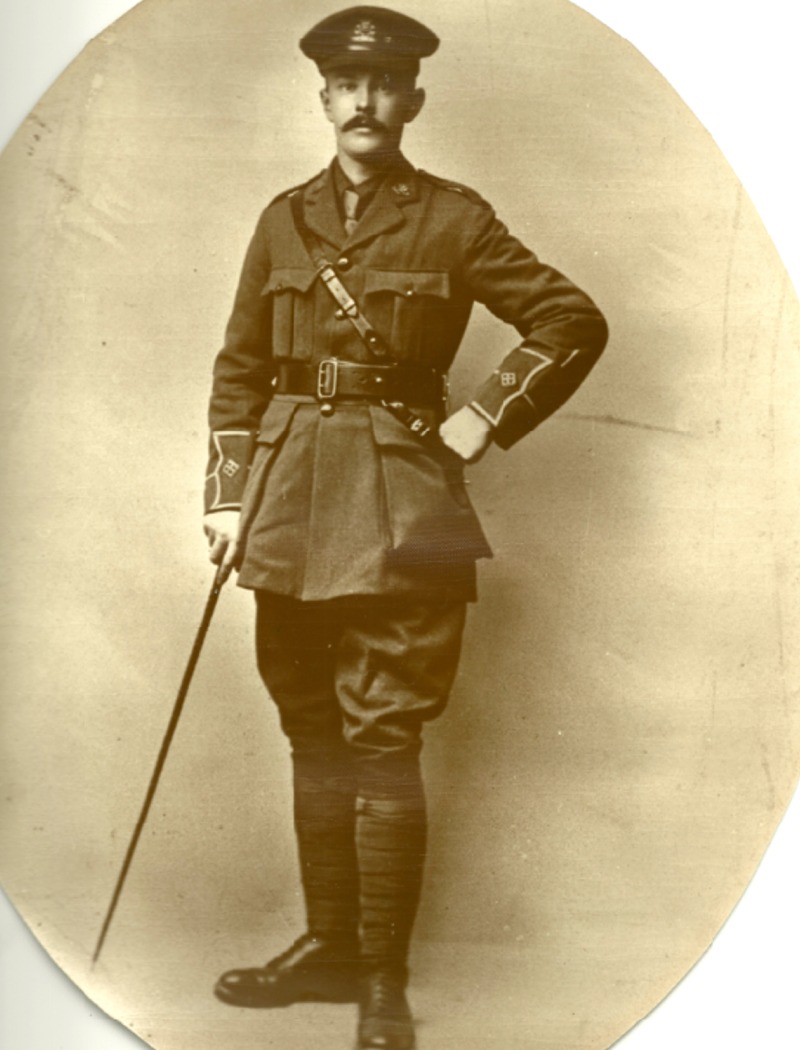 The following account of Mametz Wood, remarkable for its cool appraisal of events, was written by 18531 Sgt Thomas Phillips, a Signalling Sergeant with C Company, 16th Battalion Royal Welch Fusiliers. The account is transcribed with minor changes to punctuation and the inclusion, in brackets, of a few extra words to aid clarity.
The original document has been kindly donated to the RWF Museum by Thomas Phillips’ grandsons, Norman and Martin.
“WITH THE 38th DIVISION IN FRANCE
Previous to the second week in June 1916, the Division had been holding the British Line in sectors from LAVENTIE to LA BASSEE. About that time, it was transferred to a Mobile Division. There was a leakage of information all along the line, and even in the ranks, and the approaching push was discussed, but where (it would take place), no-one knew. A great assembly of troops at ALBERT was the only tangible bit of information I could gather. At the time movement orders were received we were in the line, and the curtailment of the battalion tour in the trenches added considerably to our inquisitiveness. We packed up hurriedly and commenced our march from LA GORGUE to RIBEMONT. Going southwards from ST POL we could see the huge blaze of our guns along the battle front. We halted at OSTREVILLE, a small country village. The marches were accomplished under cover of darkness. Along the line the guns were exceptionally busy, and the sky along the battle front was ablaze. At OSTREVILLE the Battalion went through a hard course of training “in the attack”, and there was no need for further surmise. The training was strenuous and completed in six days. From the latter place we marched to RIBEMONT. Accommodation was poor but here, as at all the other places, I found another cart which, with a good layer of straw, made a good billet. At RIBEMONT the Battalion was under orders to move at 15 minutes notice.
Tom Phillips as a 2/Lieutenant in the Welsh Regiment
At this place we saw our first batch of Boche prisoners placed in the cage. We only stayed at RIBEMONT one night. At noon the following day we were hurriedly dispatched to reinforce, leaving all surplus kit behind. After a few hours’ march we were met by guides from a (the?) Staffordshire Regiment, and ultimately found ourselves consolidating the newly occupied line of German trenches in front of FRICOURT, a village which, on the previous day, had been completely demolished by our Gunners. For the following five days we occupied these trenches, and by this time the Division had completely relieved the troops who had taken this ground.
The Battalion suffered slight casualties in this area and, at the end of the tour, marched back some distance where we bivouacked. Improvised shelters out of ground sheets were made, and it rained very heavily. The following day we had orders to move forward again, and (we) relieved the 15th RWF in the front line, which system of trenches was half a mile in advance of FRICOURT. We remained in these trenches for four or five days and, although our relief had been expected, in fact arranged but afterwards cancelled, we had orders on the night of the 9th/10th July to take Mametz Wood. Towards the evening of Sunday 10th July a message was received from the GOC Commanding, on the vast importance of taking this wood, and that it was up to the Welsh Division to maintain the traditions of the British Army and win for itself immortal glory, which it did. It was 10.00 PM when all officers were hurriedly summoned to a conference where the method of attack was fully discussed. The disposition of the Companies was as follows:
“B” and “D” Coys supported by “C” and “A”, the extension covering a front of 200 yards and going forward in successive waves. Colonel Carden, to whom this great task was entrusted, addressed the men before going into action saying, “Boys, make your peace with God; we are going to take that position and some of us will not come back.”
For the next few hours there was little time for rest of any sort, and finally arrangements had to be accelerated. At 2.30 AM on the 10th July the Battalion was assembled in extended order out of the trenches, and lay in prone position until 5.00 AM. During these 2½ hours the roar of our guns was deafening and the concerted action of the machine gunners added to the din. The suspense was very keen till we had the order to move forward at 5.00 AM.
The dawn had broken and daylight was fast approaching, enabling us to see the ground we had to cover. We slowly ascended the ridge in front of White Trench (properly called such, as it had been dug out of chalk), and within 10 minutes or so a verbal order was passed down from our right to retire. No-one seemed to know from where this order emanated, but obviously it came from the 14th RWF as they were on our right. “B” and “D” Companies had gone too far forward for this order to be communicated to them. Presumably, if it had, the dauntless and courageous Colonel Carden would not have acted on it as he had set his teeth on getting to the wood. “A” and “C” Company officers were compelled to re-enter the assembly trench in compliance with this order. Orders were rapidly passed down to open fire (as) soon as the Boche appeared in view. Seconds seemed like minutes, and minutes like hours. In due time we saw the Boche but alas, unarmed with hands up, and escorted by one or two Tommies. These prisoners had been taken by “B” and “D” Companies. One of the escort waved his arm as a signal to go forward again and out of the trench everyone leapt without waiting for definite orders from superior officers. It displayed the instinctive valour of a British Tommy and individual determination to gain the objective. On we went in single file through a heavy Boche barrage and, on the other side of the crest was a steep embankment which offered the enemy machine gunners a good field of fire. I do not remember going down this embankment at all as I was so wrapped up in the task allotted to me. I was entrusted with the communications of the 113th Brigade.
Our first objective was to get to the wood and, for the purpose of re-organisation, seek natural cover in the folds of the ground. At this juncture the enemy put up a heavy barrage of incendiary shells that burst 100 yards or so short. The sudden burst of flame which extended from the point of bursting, 200 feet high, to the ground had a demoralizing effect, as no-one in the Battalion had previously heard of them. Colonel Carden was mortally wounded within 20 yards of the wood. After a brief stay the troops went forward into the wood, entering it at the nearest point which, for the purpose of clarity, can be described as the apex of a triangle. At this point the Boche had three machine gun posts which momentarily checked our entrance. These machine gunners were dealt with.
We pressed on until the second objective was reached. I skirted the edge of the wood and ascended the slope till I could be seen by the Brigade forward telephone station, and in doing so had to dodge the bullets which were fired by snipers up in the trees. I succeeded, with the help of my signallers, to maintain communication during the whole time of this inferno, and the chief messages required to be sent were for more and more stretcher bearers. The Battalion suffered a loss of about 400 casualties in this struggle, out of 600 who went into action.
During the same evening we were relieved by an incoming battalion, and we retired to a sunken road called Queens Nullah, immediately behind the Chalk Trench. We had to be on the “qui Vive” all night as all sorts of reports were flying about. Early next morning I witnessed one of the best artillery movements I have ever seen; that of a Battery riding into action under heavy fire. We rested during the day on their left, and our time was chiefly taken up by devouring the Brigade rations which had been dumped nearby. Ample justice was made to the selection of ham, cheese, bread, rum etc which we had, as we had been on biscuits and water only during the 4/5 days we had occupied the trenches in front of FRICOURT. Our transport could not get anywhere near us. We were in very poor physical condition on the day of the 12th and, as we had been under such heavy fire for several days and nights, (we) did not regard the shelling we were subjected to on this day as of much consequence. Late in the afternoon the Boche guns got our range and pummeled Queens Nullah, causing several casualties to the few of us that remained. It was here that I narrowly escaped death myself and instead, received a wound in the chest and leg, as well as being crushed by a fall.”
18531 Tom Phillips “C” Company, 16th RWF
Thomas Phillips
Born 11th November 1881 at Llanelli.
Married Elizabeth Miller in 1909. One son ( William Growtage) born in Wrexham in 1925
Thomas enlisted in the first week of December 1914 and was given the Regimental number 18531. He was probably a pre-war Territorial and consequently may have begun the war as a Lance Corporal (Acting Sergeant) as this appears on his 1914-15 Star. He was posted to 16th (Service) Battalion Royal Welch Fusiliers.
In 1915 Thomas attended the Signalling School at Wyke Regis Camp, Weymouth. He qualified as an Assistant Instructor of Signalling. He landed in France with the 16th Battalion RWF, attached to 38th (Welsh) Division on 2nd December 1915.
Thomas Phillips’ name was included in the Times wounded casualty list dated August 30th 1916. As he states in his account he was wounded after the withdrawal from Mametz Wood. He was returned to the UK. It would appear that he was recognised as “officer material” because he was commissioned as a 2/Lieutenant with effect from 2nd October 1916. He was posted to 18th Battalion Welsh Regiment on 10th October.
On 9th April 1917 Lieutenant Phillips was Mentioned in Dispatches from Field Marshal Sir Douglas Haig for gallant and distinguished services in the field.
He survived the war and was demobilised, with the rank of Lieutenant, on 23rd July 1919.
Thomas Phillips established an Ironmongers business in Aberystwyth. His hobby was fishing and he was a Welsh National Fly-fishing Champion. He was a prominent member of the community, serving as a Rotarian and with the National Fire Service. On his death, on 10th October 1956, tributes were paid by the Town Clerk of Aberystwyth on behalf of the Town Council, and by the Chief Constable, among others.
"The Amazing Story of Private William Ashley" contributed by Dr H J Krijnen.
On 19 October 1914 the 7th Division moved on Menin in an attempt to recapture the town from the Germans, but had to pull back later in the day because of the menace of the new German 4th Army behind the left flank. The 1st Battalion Royal Welch Fusiliers had been in the forefront of the fighting, having reached Klythoek, about two miles from Menin, and had some way to go before again reaching its starting position at Broodseinde. Eleven NCOs and men were reported missing the next day, one of them Pte 4553 William Ashley of 'A' Coy, a printer's assistant from Bollington in Cheshire, who had joined the RWF Special Reserve on 22 January 1912, three months after his 17th birthday.
In the days that followed, many more men would be reported missing. Most of them would be accounted for as their names appeared on lists of prisoners supplied by the German Army or as comrades reported their deaths. But William Ashley remained missing.
Then, in late April 1915, the usual War Office letter, asking Ashley's father if he had by any chance heard anything from his son, drew an unexpected reply originating from Ashley's old employers, the Adelphi and Clarence Mills in Bollington, and addressed to the Army Pay Office in Shrewsbury:
With reference to your enquiry of a few days ago as to whether I had heard anything from my son, I now beg to hand you the following copies of two letters received from him.
Thomas Ashley his mark X
Typewritten copies of these two letters are still in Ashley's personal file. One was from a Belgian gentleman, Monsieur N. Demars, who had escaped the German occupation and had been interned in Sas van Gent in the Netherlands. The Paymaster thoughtfully provided a translation:
22nd April, 1915
Sir, Your son is very well; he is in the house of some friends near to Menin, Belgium. He is not wanting anything. He retired there toward the end of October. He was not able to rejoin his comrades having been surrounded. He has not been wounded, he is well guarded, he sees many things near the front and is waiting impatiently the moment when he can return to the army.
Cordialement, Demars
The other letter was in fact a postcard:
Dear father,
I am in the best of health,
from your son Will,
13th April 1915
The Adelphi and Clarence managing director, Mr John Wanklyn, had assisted Thomas Ashley with the letter and was wise enough to think ahead and add a cautious footnote:
Do you advice it as being safe for the parents to correspond to the address given with their son or is it likely to lead to complications?
John A. Wanklyn, Managing Director
The Infantry Record Office in Shrewsbury informed the War Office and also the Officer i/c Infantry Records of the BEF. The War Office in turn answered that the information had been noted and left it at that.
And then, apart from some rather irritated correspondence between Shrewsbury and Whitehall, continuing into 1916, sorting out the confusion caused by Ashley's name being on the lists of prisoners, more confusion about his number (thought to be 8192 by the War Office) and another letter from the War Office saying that to all intents and purposes Ashley should receive the same pay and allowances as a Prisoner of War, nothing new happened. There is no evidence of letters from Belgium or the Netherlands having been received in 1916 or 1917.
The story took a dramatic turn in 1918, when the Adjutant of the RWF Depot in Wrexham received another report on Pte Ashley's peregrinations:
13th Febry 1918. Zeerust Hotel
Schcueningen, [sic] Holland
When I was in Holzminden Camp, in Germany, a man, apparently a Belgian Civilian, working outside the wire- told me- on about 25th November 1917- in English that he was in 1st Battn Royal Welsh Fusiliers and that he had been in my Company; I am afraid that I could not recognise him but he knew me and had enquired for me from other officers walking round, so I have no reason to doubt him. It was difficult for me to talk to him, being not allowed, and I got into touch with the man later, through the orderlies, when they were working outside the Camp; among these orderlies was a man of my Company who recognised the "Belgian" he found out that the man was No 4553 Pte William Ashley, who joined the 1st Battn, from the Depot, at LYNDHURST, after their arival [sic] from Malta at the end of September 1914.
On 19th October while retiring from N of MENIN, Pte Ashley, so he said, became separated from the Battn, and to avoid falling into the hands of the Germans he hid in a Belgian cottage, disguising himself as a Belgian peasant; he hoped to escape from here later but was unable to do so. He lived there as a Belgian until he was removed in, I think June 1918 to Germany with a large part of the Belgian civilian population. He was most anxious that his true identity should not be disclosed, as it would get him, and his friends who had sheltered him, into serious trouble. I did what little I could for him while there, and told him that I would endeavour to send him things when I got to Holland; I am now aranging, [sic] through a Belgian relief committee to send him parcels. He gave me as the name of his Next of Kin Mrs Chester 7 Lord Street Burrington [sic] New Macclesfield. I have written to Mrs Chester, but I did not tell her the name under which he was now living, being afraid she might write to him and "give away" who he was. His assumed name and present address is.
Segers Joseph
Civil Prisoner
Belgian
[bottom of page damaged]
[..…] but I should not say he was in the best of Health, owing to a shortage of food.
J. Smyth Osbourne Captain
1 Royal Welsh Fusiliers
There must have been another communication, now lost, concerning William Ashley as the Infantry Records Office informed Thomas Ashley on 22 October 1918 that his son was still alive:
With reference to your son, the above named soldier, I am instructed to inform you that information has been received in War Office that the above was alive in September 1918. I am also to impress upon you that under no circumstances whatever should you attempt to communicate with him, as any attempt will endanger his life, and the lives of others who are assisting him. I would also advise you to warn any of your friends who might write to your son, that they should not do so for the reason stated above.
No records survive to tell us how William Ashley returned to the Army. We can assume that he was one of the many returning Belgian deportees, as there is a short and barely legible note on his Medical History sheet that he was admitted to 229 Field Ambulance (then stationed between Tournai and Brussels) with bronchitis on 11 December 1918. He was transferred to 51 Casualty Clearing Station the same day and a few days later evacuated to the UK on the Belgian steamer 'Pieter Coninck', then was admitted to Hammersmith Hospital on 17 December and discharged to the Depot on 17 December. He was granted a furlough from 20 December to 20 February 1919, and during his leave he was transferred to Class Z, returning to civilian life but with the obligation to return if called upon to do so.
There appears to have been little official recognition for his amazing adventure. He did not receive any medals apart from the 1914 Star and the British War and Victory Medals. On 2 April 1919 the War Office decided that he did not qualify for the bounty of 15 pounds given to serving soldiers.
Contributed by Dr H J Krijnen
9th Battalion, Royal Welch Fusiliers, at the Battle of Loos, 1915
An account taken verbatim from the War Diary entries compiled by Major Charles Burrard, 2nd-in-Command of the Battalion. Footnotes by Christopher Fyles, great-grandson of Sergeant John Thomas Nicholls, DCM, who served in the 9th Battalion from its formation in 1914 until his discharge in March 1919.
24th September 1915: Brigade H.Q. moved to Advanced Report Centre. Very wet + muddy. Our artillery continued to bombard.
We had been in the trenches since Aug 30th + our total casualties up to the evening of the 24th had been 2 men killed and 11 wounded. On the evening of the 24th Lt Col MADOCKS (sic) [1] and his battalion Hd Quarters moved up to A company mess in the firing-line. He asked me (Major C. BURRARD) to meet him there at 4.15 a.m. [2] the next morning. I retired for the night to a disused dug-out I found in one of the old support trenches. It was then drizzling.
25th September 1915: I met the C.O. in A company mess at 4.15 a.m. + had some coffee. I then went back to my dug-out. It was drizzling + what breeze there was seemed to be unfavourable for the use of gas; I began to think the attack would be postponed.
5.50 a.m. Our artillery started a furious bombardment.
I hurried down to the firing line and found the smoke candles at work. On my way there, I observed a mile to the south, a thin cloud floating slowly toward the German lines; this I took as asphyxiating gas. The breeze was still very slight but seemed to have turned temporarily in our favour. It was not to be depended on however + too weak + I am of the opinion that the pall of smoke in front of our lines did more harm than good as it brought on inactivity on the part of our Artillery. The smoke was intended to supplement the gas + mislead the Hun into believing that there was an immense amount of that commodity coming towards them. None of our men were injured by our own gas, though I believe a few of the 6th Wilts [3] suffered.
6.30 a.m. About this time I was informed that a sheaf of rockets had been sent up by the Brigade, intimating the commencement of the attack. I personally did not see it. From subsequent inquiry I learnt the following which bore out to some extent the message sent by the Artillery Observation Officer at 6.25 that the Royal Welch were already attacking. Col. Madocks remained at A company mess till the sheaf of rockets went up, he then told Captain HOYLE, commanding A company to commence the attack (A company was to be directing). Captain HOYLE proceeded to No 10 sap but he had already at 6.15 a.m. had men out in the sap & I think it is probable that his leading platoon was already extended, lying down, in line with the head of the sap, ready to advance.
The order had been issued to be ready to commence the attack at 6.30 a.m. This order might be differently interpreted. It should have been made clear whether troops were to enter the sap or remain behind the parapet till 6.30 a.m. The leading platoon of A company being extended in front of the sap it is possible an advance was made before Capt HOYLE returned from HdQrs. At any rate an officer of B company on the left whose company was keeping in touch with A looked at his watch when the advance commenced and it was 6.20 a.m.
The pall of smoke was very thick; Capt HOYLE had orders for his directing flank to march on a certain willow tree but this was now hidden from view + it is believed he diverged to the right in front of the 9th Welsh [sic, 4].
The Artillery observation officer who had wired down that the attack had commenced, about this time surpassed himself by ‘phoning that the 9th R.W. Fus. Had taken the first line of trenches. This must have been an effort of the imagination on his part as owing to the smoke, nothing could be seen.
Messages like this led to wild rumours after the action of spies having tapped the wires.
At about 6.50 I met Lt Col. Madocks & his Adjutant in one of the centre bays. He seemed very optimistic and asked me if D company was out yet; if so, we would follow.
The arrangements for attack were as under:-
B Coy{---------------- ---------------}A Coy 50 yards
---------------- -------------- distance
---------------- -------------- between
---------------- -------------- platoons
D Coy {---------------- -------------}D Coy
---------------- --------------
I reported that D company was not yet out.
A quarter of an hour later Captain HOGG the Adjutant again went to inquire + in the meantime Col. MADOCKS who was observing over the parapet was struck by a shot in the temple + fell dead at my feet. It was evident by this time that things were not going well; not much could be seen on account of the smoke but there were rumours of the saps being encumbered with wounded which accounted for the delay with D company. – I had seen Capt ACTON, comdg D company a few minutes before just outside our wire entanglement + I suggested to Capt HOGG to get into communication with him + obtain his opinion; Capt HOGG had been gone about 10 minutes when I received information that both he and Capt ACTON had been shot.
The 6th Wilts were now beginning to arrive; to avoid a useless sacrifice of life I gave orders for a retirement. Col. JEFFRIES, comdg 6th Wilts. who arrived shortly afterwards concurred with me.
Our action north of the LA BASSEE canal was intended as a demonstration, the principle attack being carried out south of the canal; our energetic action was the means of withdrawing several battalions of reserve to our front, which the Germans could have utilised further south. But could not this advantage have been gained without such loss of life? Undoubtedly both the G.O.C. 58th Brigade + Col. MADOCKS had been misled as to the damage our Artillery had effected on the enemy’s wire after several day’s bombardment also the effect it had had on the enemy’s morale; the effect on the wire was, as a matter of fact, negligible + the onus of not reporting this, of not making a more thorough reconnaissance rests on the companies who were in the front line; it was unduly optimistic to suppose that the enemy’s morale had gone, as during a bombardment the Germans are adept at burrowing themselves into specially deep dug-outs or keeping out of the way.
It was confidently believed that we should have no difficulty in rushing across the intervening space + capturing the German front + support trenches.- When the time came to carry this out we found ourselves up against a row of impenetrable wire and the intervening ground swept by half-a-dozen a machine guns.
C company under Capt K.NICHOLL had been detailed to act as a flanking party + moved up FIFE ROAD. They suffered severely from the enemy’s artillery which was most accurate.
The remainder of the morning was taken up in moving the remnants of the battalion to the Reserve Line. During the hours of darkness many of the wounded were brought in.
The following is a list of the casualties on Sept 25th :-
Killed (Officers) – LT.COL. H.J. MADOCKS, CAPT. C.A. ACTON, CAPT. E.C. PAYNE, CAPT. L.S. HOGG, CAPT. B.W.E. HOYLE, LIEUT. C.F.J. SYMONS, 2nd LT. R.J. WILLIAMS.
Officers wounded – LIEUT. H.J. WILLIAMS, LT. G.H. CHARLTON, 2nd LT. R.H. HIGHAM, 2nd LT. C. FAWCETT
For table - click here
It is believed a few of the missing are prisoners of war.
The numbers that went into action were :-
25 officers, 781 rank & file
Footnotes
[1] Lieutenant-Colonel Henry John Maddocks, C.O. of 9th Battalion, R.W.F., killed-in-action 25/09/15 and buried in plot I.F.20 in Brown’s Road Military Cemetery, Festubert.
[2] The 24-hour clock system was not in general use until later in the War.
[3] 6th Battalion, Wiltshire Regiment, part of 58th Brigade along with 9th R.W.F. They were in Support on 25th September, behind the R.W.F.
[4] 9th Battalion, Welch Regiment, also part of 58th Brigade and on the right flank of the R.W.F.
Contributed by Christopher Fyles
13621 Sgt John Thomas Nichols DCM
Sgt Nichols was the contributor’s great-grandfather.
He was born in St Helen’s Lancashire and died in 1945.
He served with 9th Battalion throughout the Great War and was awarded the DCM for his gallantry in action at Messines in the summer of 1917. The citation read: “For conspicuous gallantry and devotion to duty. He reached the enemy’s lines some distance ahead of his assaulting platoon, whereupon he attacked twenty of the enemy single-handed, bayoneted three of them and kept the rest prisoners until the arrival of his platoon. He later showed marked ability and coolness in assisting his company commander under heavy shell fire.”
 Lt Col H J Maddocks, Commanding Officer of 9th Battalion, killed in action at Loos on 25th September 1915. Lt Col H J Maddocks, Commanding Officer of 9th Battalion, killed in action at Loos on 25th September 1915. |
He commanded the Battalion prior to the appointment of Lt Col Maddocks in August 1915. |
 Major C Burrard, who wrote the 9th Battalion War Diary at Loos.
Medals awarded to Siegfried Sassoon
In 2007 The Royal Welch Fusiliers Regimental Museum was fortunate to acquire, with the assistance of members of his family, the Military Cross awarded to Siegfried Sassoon.
Siegfried Sassoon is probably the best known of the war poets of 1914-18. His public objection to the war in 1917 was a brave stand against the might of the military and political authorities of the period and paved the way for future generations to think as individuals about the realities of war rather than to accept, without questioning, the views of others. Sassoon sowed the seeds of a peace movement that flourishes today ninety years after his solitary protest.
Siegfried Lorraine Sassoon (1886-1967), author, war poet and anti-war objector, served as an officer with the Royal Welch Fusiliers from 1915 until 1919 and won the Military Cross in May 1916 whilst attached to the 1st Battalion serving in France.
Nothing in his background had prepared Sassoon for the reality of war, or indeed for life outside his privileged and introverted world. The war, with its brutality, the suffering it caused and its physical and emotional deprivations, brought Sassoon to a crisis that he could not comprehend and which, as he learned later from W H Rivers at Craiglockhart, he had lacked the objectivity to deal with.
The Military Cross physically represents Sassoon’s crisis point.
Despite his shy, sensitive nature, and struggling with his sexuality, Sassoon displayed extraordinary courage, heroism and leadership on the Western Front. Nick-named “Mad Jack” by his fellow officers, his exploits, fuelled by grief and often suicidal, had a manic quality. He set out deliberately to win a Military Cross with the same determination he had showed in winning pre-war steeplechases. When it came, his Military Cross was won for his part in a failed trench raid near Fricourt on the Somme battlefront. With the raiders pinned down by enemy fire and grenades he organized the collecting and bringing back of the wounded and dead under heavy fire.
Sassoon believed that the only escape from the agonies of war was to be at its centre where there was no time to rationalize. His poetry written at the Front, sharpened and toughened by his experience, was truer as a result. Returned to England with respiratory problems in July 1916 Sassoon made contact with pacifists, notably the Morrells, Bertrand Russell and leading members of the Bloomsbury Group, who eagerly fed his uncertainties. With his conviction about the rightness of the war shaken, and wracked with guilt for not being at the Front, Sassoon wrote about his Military Cross - “My absurd decoration is the only thing that gives me any sense of responsibility at all.”
Back at the Front Sassoon longed to go home or to be shot dead - the ultimate release. His loathing of those who desired and conspired for the war to continue fuelled his satire. A selection of his poems, which he knew might cross the line of acceptable comment, was published in October 1916.
A wound returned Sassoon home again in April 1917. By this time he had rejected poetry as his sole means of protest. He set about writing a statement for publication in which he would declare “on behalf of soldiers” that the continuance of the war was no longer justified. His pacifist supporters immediately saw in it a powerful publicity coup - an anti-war statement made by a known writer who was a war hero with the Military Cross. Sassoon’s “Statement” was completed on 15th June 1917. Copies were sent to supporters and the Statement was made public.
Fellow writer and RWF officer Robert Graves, along with other friends scared for Sassoon, worked hard to persuade the military authorities that his actions were the result of war weariness and that his case should be treated as a medical condition rather than as a rebellion. But Sassoon was determined to avoid any suggestion of mental breakdown or exhaustion. A Medical Tribunal was to be avoided at all cost. Sassoon wanted to be court-martialed as the publicity aroused by a British officer protesting against the war might encourage others to speak out.
Higher authorities wished to prevent the Statement from becoming a public cause and Sassoon was given time to reconsider. By playing it along the Army took the sting out of the protest. Sassoon’s patience was thin. By now back with 3rd Bn RWF at Litherland near Liverpool, he took the train to Formby, and in a fit of frustration and anger, he tore off the Military Cross ribbon from his tunic and threw it into the Mersey. “The poor little thing fell weakly onto the water and floated away as though aware of its own futility”. It was the most extreme act of rebellion against the Army that Sassoon could conceive.
Eventually, convinced by Graves that he would never get a court-martial and that if he continued to refuse a Medical Board he would be silenced by being sent to a lunatic asylum, Sassoon submitted. His Medical Board declared that Sassoon was suffering from Neurasthenia and referred him to Craiglockhart War Hospital and Dr W H R Rivers.
Most reports of the Formby incident state that Sassoon threw his Military Cross into the River Mersey. That his protest involved only the ribbon, and not the medal itself, is itself an interesting reflection on his tortured ambiguity. The Military Cross itself remained among Sassoon’s possessions until forty years after his death.
Later in the year, to accompany the Military Cross the Museum was loaned The Queen’s Gold Medal for Poetry awarded to Siegfried Sassoon in 1957. Both medals are displayed in the Regimental Museum in the Castle, Caernarfon.
Siegfried Sassoon’s Military Cross and ID tag - image coming soon..
The Queen’s Gold Medal for Poetry, awarded to Sassoon in 1957. The Gold Medal For Poetry was instituted by King George V in 1933 at the suggestion of the then Poet Laureate, Dr John Masefield. - image coming soon..
The reverse of the Queen’s Gold Medal for Poetry. The design by Edmund Dulac (1882-1953), shows “Truth emerging from her well and holding in her right hand the divine flame of inspiration – Beauty is Truth and Truth is Beauty”. - image coming soon..
Private Samuel E. Hall (11th Battalion RWF) & The Forgotten Front (Salonika 1916-18) by Dr. C. M. Hall
After the out break of World War One on 4th August 1914, young patriotic men all over the country rallied to Kitchener’s call to enlist for ‘King and Country’. Initially filled with nostalgic ideas of warfare, the combination of old tactics and new weapons soon led to the horrors of trench warfare, something that no soldier had ever envisaged. The well known battles of Verdun, Jutland, the Somme and Passchendaele claimed many young British lives, wiping out an entire generation during four long years. However, the “Forgotten Front” of Macedonia and Salonika 1916-1918 has not received as much attention as Gallipoli and Mesopotamia as it was regarded at the time as a sideshow. The 11th Battalion of the Royal Welch Fusiliers endured nearly all but two months of the War in Salonika. It was in the final few months before the end of the War that many who had survived the appalling conditions and enemy fire, fell at the Battle of Doiran in Salonika. One of those soldiers was Private Samuel E. Hall.
Private Samuel E. Hall (born 1895) was the oldest of four children. His father, Joseph Hall (b. 14th April 1861), a stone mason and a lay preacher, and his mother Jane Hall (b. 16th January 1873) resided at 2 Mount Pleasant, Penrhynside, Llandudno. Two of his brothers, Ephraim (Navy) and William (Army) fought during World War One, with Ephraim and the youngest of the four, Joseph, fighting during the Second World War.
As the eldest child of age, Private Samuel Hall was the first to enlist. He enlisted at the Town Hall on Lloyd Street in Llandudno (see recruitment poster below). Like so many of the so called ‘pals’ he enlisted with childhood friends who also resided on Mount Pleasant. He was joined by Edward Evans (3 Mount Pleasant) who, having enlisted in Wrexham went on to be a driver in “B” Battery of the 298th Brigade, Royal Field Artillery. He was killed in action on the 30th November 1917. Then there was Robert Harris, son of Robert and Annie Harris of 10 Mount Pleasant. After enlisting in Colwyn Bay, Harris went on to be a private in “B” company of the 14th Battalion of the Royal Welch Fusiliers. Robert fell on the 2nd September 1917 aged 27. Lastly there was George Frederick Sanford (13 Mount Pleasant) who was a private in the 1st Battalion of the Royal Welch Fusiliers. He saw very little of the war as he was killed in action on the 30th October 1914 aged 24.
After enlistment Private Samuel E. Hall was assigned to Wales’s oldest infantry regiment, the Royal Welch Fusiliers. The 11th Battalion was formed at Wrexham on 18th September 1914. Shortly after forming it joined the 22nd Division. The whole division then moved on to various camps for training before making the journey to France in early September 1915. After a brief stint in France it received orders on 20th October 1915 to move to an unknown destination. Ten days later, on the 30th October, Private Samuel E. Hall’s battalion, along with the 8th South Wales Borderers and a fragment of the Shropshire Light Infantry, sailed for Salonika at 4.30pm.
After a relatively calm passage, they anchored in Salonika harbour on the 5th November. They joined British troops who had already been there one month before. Private Hall, along with the rest of British troops in Salonika, was there to deter Bulgaria from joining Germany and Austria-Hungary, in attacking Serbia. The war in Salonika was regarded by the British as a ‘side show’ as Britain had no political, commercial or strategic interests in the region apart from seeing the First World War to a favourable conclusion. Conditions in Salonika were appalling. Many men had arrived in light summer khaki, but in November 1915 they faced blizzards and dense fog. There was a lack of roads so the state of the ground meant terrain was impassable in parts with army vehicles sinking into the mud. When summer arrived in 1916, they were faced with soaring temperatures. Consequently disease set in and spread like wildfire. In Salonika, for every casualty in battle, three died of malaria, influenza or other diseases.
Private Samuel E. Hall endured enemy fire, disease, exhaustion and lack of supplies for nearly four years in Salonika. Sadly he did not make it home as he fell at the Battle of Doiran on the 18th September 1918, just weeks before the end of World War One. The Battle of Doiran took place on the 18th and 19th September 1918 in the area of Dora Tepe-Doiran-Karasuli Railway and the river Vardar. The 22nd Division (which included the 11th Battalion RWF) was ordered to take Doiran Hill, Teton Hill and the Petite Couronne. This would be no easy task. The enemy was tactically at an advantage with a good network of well dug in trenches, the terrain was difficult to cross and the wire entanglements were exceptionally good. Also, due to an extremely hot summer the Battalion was struck by an epidemic of influenza, malaria and dysentery. Facing the gloomy prospect of no reinforcements, the troops were exhausted.
The Battle of Doiran was a disaster for the British. In attack after attack the British lost many lives due to an enemy which had a far superior vantage point and prior knowledge of the terrain. The British attempted to take various enemy lines but were met with heavy counter-attacks and gas. During the 18th September 1918 the 11th Battalion RWF was ordered to leave Senelle and move to take enemy trenches near Dagger and Sabre Ravines. After meeting heavy counter attacks it then moved on with remaining troops to the Hilt where it faced even heavier opposition. A few men managed to secure the Hilt but were later pushed back. It was impossible to re-take the Hilt due to a lack of sufficient manpower. Instead they chose to consolidate the line crossing Jumeaux Ravine and Root Ravine. They beat off a weak counter attack by the enemy and dug in for a quiet night. Sadly, they had experienced huge losses throughout the day. Out of 20 officers, only 3 survived and out of 480 soldiers, only 100 survived. Aged just 23, Private Samuel E. Hall was one of those 380 who did not survive the Battle of Doiran.
The eminent historian A.J.P Taylor commented that ‘the battle of Doiran is a now forgotten episode of World War One.’(1981) With the commemoration of the 90th Anniversary of the end of the First World War this year, accounts such as those who fell on the ‘forgotten front’ should be remembered. Soldiers like Private Samuel E. Hall fought on a ‘forgotten front’ in what became a forgotten army, but today in the 21st Century he is not forgotten.
We will remember them.
 Pte Hall’s grave in Doiran Cemetery (photograph by courtesy of Dean Freeman) Pte Hall’s grave in Doiran Cemetery (photograph by courtesy of Dean Freeman) |
 Private Samuel E. Hall
(Source: Hall Family Collection) Private Samuel E. Hall
(Source: Hall Family Collection) |
 (Source: Caernarfon Record Office, Gwynedd Archives Ref: XM/6601) (Source: Caernarfon Record Office, Gwynedd Archives Ref: XM/6601) |
 PENRHYNSIDE WAR MEMORIAL PENRHYNSIDE WAR MEMORIALUnveiled on Wednesday 25th May 1921 at 3 p.m. by Captain A. Taylor Private Samuel E. Hall is commemorated on this memorial. |
Ellis Humphrey Evans “Hedd Wyn”
Ellis Evans was born on 13th January 1887 in Pen Lan, a house in the middle of Trawsfynnydd in Meirionydd, North Wales. He was the eldest of 11 children born to Evan and Mary Evans. In the spring of 1887 the family moved to a farm Yr Ysgwm, a few miles from Trawsfynnydd.
Ellis Evans received a basic education at elementary and Sunday school. He was not a brilliant pupil but he had a natural gift for poetry. He wrote his first poems at the age of eleven. He left school at fourteen and began work as a shepherd on his father’s farm.
He took part in eisteddfods from the age of 19 and won his first bard’s chair at Bala in 1907. In 1910 he took his bardic name “Hedd Wyn” which in English means “Shining Peace”, a reference to the sun’s rays penetrating the mists in the valleys of Meirionydd. Hedd Wynn’s main influence was Shelley and themes of nature and religion dominated his work. In 1913 he won the chairs at Pwllheli and Llanuwchllyn and in 1915 he was successful at Pontardawe and Llanuwchllyn. The same year he wrote his first poem for the National Eisteddfod, “Eryri” an ode to Snowdonia. In 1916 he took second place at the Aberystwyth National Eisteddfod with an ode to the medieval abbey Strata Florida. He determined to win the chair the following year.
By this time the Great War was at its height. There was great support for the War in Wales and David Lloyd George, Prime Minister from 1916, urged his countrymen to make sacrifices for the war effort. Welshmen had volunteered in large numbers from 1914 and the introduction of conscription in late 1916 did not undermine support.
Naturally the War affected Hedd Wyn’s work and produced some of his best poetry including “Plant Trawsfynnydd” (“Children of Trawsfynnydd”), “Y Blotyn Du” (“The Black Mark”), “Nid â’n Ango” (“Do Not Forget”) and “Rhyfel” (“War”).
The Evans family in 1916 was faced with a difficult choice – one of the sons must join the forces despite farming being work of national importance. Ellis enlisted rather than his younger brother Bob, who was married. In February 1917 he received his training at Litherland Camp, Liverpool where his stoical but cheerful disposition made him well-liked. In March 1917 the Government called for farm workers to help with ploughing and many soldiers were temporarily released. Hedd Wyn was given seven weeks’ leave. He spent much of this time working on “Yr Arwr”, his entry for the National Eisteddfod. He returned to training in May, well satisfied with his progress.
In June 1917 Hedd Wyn joined the 15th Battalion Royal Welch Fusiliers at Fléchin in France. His arrival depressed him. “Heavy weather, heavy soul, heavy heart. That is an uncomfortable trinity, isn’t it?” Nevertheless at Fléchin he finished his National Eisteddfod entry and signed it “Fleur de Lis”. It left with the post on 15th July 1917. The same day his Battalion moved towards the Front Line in readiness for the major assault which would be known as the Third Battle of Ypres or simply as Passchendaele.
The attack began on 31st July 1917 at 0350. Heavy rain turned the battlefield into a swamp. The 15th Battalion took Pilckem and then advanced towards Iron Cross, coming under heavy artillery and machine gun fire. Hedd Wyn was hit in the chest by shrapnel and carried to a First-Aid Post. Still conscious he asked the doctor “Do you think I will live?” It was clear that he had little chance of surviving. Hedd Wyn died at about 1100, one of many thousands of casualties that day.
On 6th September 1917 the ceremony of Chairing the Bard took place at the National Eisteddfod, held that year at Birkenhead. David Lloyd George was present. The adjudicators announced that the entry of “Fleur de Lis” was the winner and the trumpets were sounded for him to identify himself. No one stood up and eventually it was discovered that the winner had died six weeks before. The empty chair was draped in black. “The Festival in tears and the Poet in his grave” said the Archdruid Dyfed.
Ellis Humphrey Evans, “Hedd Wyn” is buried in Artillery Wood Cemetery at Boezinge. His collected work “ The Shepherd’s Poems”, was published in 1918.
 Ellis Humphrey Evans – “Hedd Wyn” Ellis Humphrey Evans – “Hedd Wyn” |
 The Black Chair, won posthumously by Hedd Wyn at the 1917 National Eisteddfod at Birkenhead. The Black Chair, won posthumously by Hedd Wyn at the 1917 National Eisteddfod at Birkenhead. |
Rats shot during the pulling down of an old dugout in Ploegsteert Wood, by David Jones - David M. Bownes
This pencil sketch is from a series of drawings by David Jones which record his experiences as a private soldier during the First World War. It was drawn in November 1916 while he was serving as an observer with the 2nd Field Survey Company at Ploegsteert Wood. The subject matter is characteristically mundane, reflecting Jones's interest in the more everyday aspects of soldiering. Other illustrations, which filled his army note books, depict equipment, buildings and friends he served with.
David Jones enlisted with the 15th (1st London Welsh) Battalion, Royal Welch Fusiliers, in January 1915, aged 19. The battalion was initially raised from Welshmen living in London, where Jones was studying at the Camberwell School of Art. After training in north Wales and Winchester, Jones accompanied the battalion to France as part of the 38th (Welsh) Division. He saw action during the battle of Mametz Wood (July 1916), where he was wounded, and later at Bosinghe, Pilkem, Langemark and Passchendaele (1917). In February 1918, Jones was invalided home with Trench Fever and spent the rest of the war in Ireland.
After the war, his reputation as an artist and writer grew enormously. He became a leading member of the Eric Gill group of artists and a watercolourist of international fame. In 1937 he published In Parenthesis - an acknowledged literary masterpiece which charts his war-time journey from raw-recruit to seasoned soldier. He was also an accomplished engraver and left a legacy of highly individual lettering. He died in October 1974, and is buried in Ladywell Cemetery in south-east London.
 Private David Jones Private David Jones |
|
 Rats shot during the pulling down of an old dugout in Ploegsteert Wood.


The de Walden 'Trench Knife' - Martin J. Milner
 Lord Howard de Walden was second-in-command and commander of the 9th Battalion, Royal Welch Fusiliers between November 1916 and December 1917. He was a wealthy and philanthropic man, with interests in Welsh history, and had given substantial quantities of equipment to his previous regiment, the Westminster Dragoons. He was also a collector of arms and armour, and this had brought him into contact with Felix Joubert, a fellow collector and also a pre-eminent artist/craftsman/restorer. In 1916, Joubert patented a knife for trench fighting which had an 18" leaf shaped blade, nearly 3" wide at its maximum. The pommel was pointed so that it could, in theory, be used as a weapon. The guard was circular and could be folded flat against the blade when the knife was not in use, a feature that would have allowed the knife to be patented. As always, Lord Howard wished to equip his troops as well as possible, and so he had knives made for the 9th Battalion. Some of the surviving examples have Joubert's mark (an intertwined Jo) on them, and also Dros Urddas Cymru ('for the honour of Wales'). The Regimental Museum has one knife on display and a further 6 in the reserve collections.
It has often been claimed that the design of Joubert's knife is based on a specifically Welsh design used by Welsh archers at Crecy. This is, however, romantic nonsense, and there is no evidence to suggest that any specifically Welsh form of sword or dagger existed.
 The Regimental Museum's collections include a manuscript account of WWI experiences by H Lloyd Williams of the 9th Battalion which mention the use of the knife in action. At the start of the battle of Messines, 1917, one company raided German trenches on the 5th June. The account includes the following:
"..and the Lewis gunners, furnished with the strange knives furnished by Lord Howard de Walden, the whole Company, in conjunction with the King's Liverpools on the left, climbed over the top, and dashed under the barrage into the enemy trenches."
Wilkinson Sword made one of these weapons in 1981 for the centenary of the Welsh Rugby Union. It was specially embossed with the names of each captain over the previous 100 years.
THE DUALA GUN
The Duala Gun has, for many years been on display at Hightown Barracks, Wrexham. Presented to The Regimental Depot of The Royal Welch Fusiliers shortly after the First World War it has been exposed to the elements throughout its time at Hightown. The weather had taken its toll on the gun and by 2008 it was in a poor state of repair and in danger of collapsing altogether. The impending arrival of 1 Royal Welsh at The Dale Barracks provided an opportunity to restore the gun and place it in a position, under cover, outside the 1st Battalions’ Headquarters. Through the an initiative of the trustees of the RWF Regimental Museum, the REME LAD at The Dale Barracks agreed to take on the mammoth task of restoring the gun.
The Duala gun was captured from the German Army in West Africa in September 1914. It is a Krupp 9 cm field gun built in 1892. Nothing is known of how the gun came to be in West Africa, the detailed circumstances of its capture or how and indeed when it made its way to Hightown Barracks. There is an inscription on the trail which reads:
FIELD GUN
CAPTURED FROM THE GERMANS
AT THE TAKING OF DUALA
BY THE ALLIED FORCES
27TH SEPTEMBER 1914
THE FOLLOWING PAST AND PRESENT
ROYAL WELCH FUSILIERS WERE ENGAGED
BRIGADIER GENERAL C. M .DOBELL DSO ADC
COMMANDING EXPEDITION
MAJOR J. B. COCKBURN
COMMANDING NO 1 BATTALION
NIGERIA REGIMENT
CAPTAIN L. D’A. FOX
SIERRA LEONE BATTALION
LIEUT G. E. R. DE MIREMONT
A.D.C. TO G.O.C.
LIEUT J. G. BRUXNER-RANDALL
SIGNALLING OFFICER
COLOUR SERGEANT H. WILLIAMS
NO. 7715? PRIVATE H. ROGERS
It would appear that the gun was the spoils of war for the expedition commander, Brigadier General Charles Dobell, late RWF.
Having agreed to take the project on The Dale Barracks LAD under SSgt Morton and his team were left with the task of replacing the wheels and restoring a number of elements of the gun which were heavily corroded. With the assistance 101 Battalion REME in Wrexham the gun was transported to Donnington for sand blasting and then recovered to The Dale Barracks. New wheels were fabricated by the Wheelwrights for the modest cost of £1000. Many hours of labour later the gun’s refurbishment was completed undoubtedly saving the gun from impending disposal as beyond repair. The Museum trustees are extremely grateful to SSgt Morton, and his team for their hard work in saving this important piece of Regimental history for posterity.
 Duala Gun before Restoration Duala Gun before Restoration |
 Duala Gun following restoration work Duala Gun following restoration work |
The 1st Battalion The Royal Welch Fusiliers first made contact with the Germans on 14 May 1940 on the River Dyle at Ottenburg, north of Wavre and some 20 km south-east of Brussels. The forward company was subjected to intense mortar fire and a series of unsuccessful attacks throughout the following day. Meanwhile the Germans had broken through near Sedan, threatening the southern flank of the British Expeditionary Force (B.E.F.), and orders for the Battalion to withdraw came on the night of 15-16 May.
Trucks which had been promised to carry them back to the River Escaut failed to arrive and for three days the move had to be made on foot, while every night defensive positions had to be dug and manned. Meals were hurried and irregular, rations frequently supplemented by slaughtered livestock, but nothing interfered with the Battalion's ability to march. In one period of thirty hours they covered forty miles without leaving a single straggler behind. Late on 18 May the trucks eventually arrived and took the Battalion to Tournai on the Escaut where they held the river line for forty-eight hours, being heavily shelled and bombed. Everyone was now extremely tired and few in the Battalion had had more than two hours sleep in each twenty-four hour period.
Late on 20 May, with the German forces again threatening to outflank the BEF, they were told to withdraw to the area north of Béthune, where they arrived on 24 May, and were given an assurance that the brigade was going into rest as a reserve formation. This rest lasted only two hours, because they were then ordered to advance westward to capture four bridges over the La Bassée Canal, south of Saint-Venant, which was part of the so-called Canal Line. This was an important obstacle if the B.E.F. was to form a new front facing south and west, while simultaneously holding off the German attacks from the east.
The fact that one weary battalion had to be ordered to capture four bridges over a distance of three miles is indicative of the straits to which the B.E.F. was now reduced. Their task was made no easier when the only fire support available, one remaining 3-inch mortar, came to grief. When eventually four field guns arrived to support the Battalion, their forward observation officer had no map, and since the whole Battalion had only four inadequate maps, the indication of targets was all but impossible. All maps of France had been withdrawn from the Battalion when it moved into Belgium.
A first attempt to capture the bridges was made on the evening of 24 May with most of the Battalion advancing westward, parallel to the Canal de la Lys on their right. They took the hamlet of Saint-Floris, but could not force their way into Saint-Venant. Meanwhile D Company ran into an ambush and suffered heavy casualties. Next morning B Company took the village of Robecq, south of Saint-Venant, with the company advancing in open order using fire and movement by platoons -a copy-book exercise culminating in a bayonet charge. Unfortunately, although they reached one of the bridges just beyond the village, they found themselves surrounded and besieged, with three of their four officers wounded. They held the village until darkness on 26 May when the survivors broke out in small parties. Very few of them reached safety.
Meanwhile the Battalion had captured Saint-Venant on the morning of 25 May with prisoners taken and casualties inflicted on the enemy. These attacks were the only occasion in the campaign when a British battalion retook ground captured by the Germans. A and C Companies pushed on, aiming for the more westerly bridge. A quarter of a mile from their objective they were pinned down in open ground by enemy fire and had great difficulty in regaining their start line in Saint-Venant.
Apart from heavy shelling and the sight of numbers of German tanks and infantry moving across the front, 26 May was uneventful. The Durham Light Infantry took over Saint-Floris, allowing the Battalion to concentrate around Saint-Venant. Having sent the transport over the canal, Lieutenant Colonel Harrison sought permission to withdraw to the north bank, but this was refused, so the Battalion settled down to await the inevitable attack. This started at 8 a.m. on 27 May, and it was soon clear that no weapons were available that could stop the medium tanks of the 3rd Panzer Division. At 9 a.m. the Brigadier ordered the D.L.I. to fall back through the Royal Welch, but they were too closely engaged to extricate themselves. Colonel Harrison therefore ordered all his men who could get clear to double back over the canal bridge which was now under machine-gun fire from both sides. He followed them but was killed shortly after reaching the north bank. At this stage it was found that the engineers waiting to demolish the bridge were no longer there, so that the German tanks were able to cross on the heels of the survivors, killing some and taking others prisoner.
Altogether since 10 May, the Battalion had suffered some 750 casualties killed, wounded, missing and taken prisoner. The memorial to those who died is sited near the bridge, now removed, where so many of these casualties occurred, and near the cemetery where at least thirty-one of them are buried. The precise number will never be known because the cemetery contains the graves of forty British soldiers who have not been identified. It is likely that they include some of the twenty-five men of the Battalion who have no known grave.
It would be inappropriate to mention by name those who won honours and awards during May 1940, as, because of the circumstances, many acts of gallantry must have gone unreported. It should, however, be known that members of the Battalion won the following awards:
Military Cross 2
Distinguished Conduct Medal 3
Military Medal 5
Mentioned in Despatches 15
 The RWF Saint-Venant Memorial The RWF Saint-Venant Memorial |
 Men of 1RWF, Spring 1940 Men of 1RWF, Spring 1940 |
Goražde Force - The 1st Battalion The Royal Welch Fusiliers in Bosnia 1995
By Colonel Nick Lock OBE
With the death of the leader of Yugoslavia, Marshal Tito in 1980 and the end of the Cold War following the fall of the Berlin Wall, the country of Yugoslavia rapidly descended into civil war. Europe had not seen such levels of ethnic violence since the end of the Second World War. A number of small, international, observer missions were deployed to the region but this did little to stem the tide of a vicious inter-ethnic conflict. Public and press opinion in Great Britain finally led, in September 1992, to the deployment of HQ 11 Armoured Brigade and 1st Battalion the Chesh-ire Regiment, an Armoured Infantry Battlegroup, equipped with Warrior armoured vehicles. The first British soldier to be killed in Bosnia was a Royal Welch Fusilier,_Lance Corporal Wayne Ed-wards, who had been attached to the Cheshire’s Battlegroup. British Forces were deployed un-der a United Nations Security Council Resolution as part of the UN Protection Force (UN-PROFOR). UNPROFOR’s mandate under which the force operated was limited to Peacekeep-ing rather than Peace Enforcement (using force to impose a peace). The British contribution to the mission continued to expand through 1993-94 by which time there was a full brigade of troops, including armoured infantry and mechanised infantry battlegroups, an armoured recon-naissance regiment, engineer regiment and supporting logistics troops. The force was distributed through central Bosnia Hercegovina, with the majority of the mechanised battlegroup deployed to the eastern enclave of Goražde, with D Company detached in central Bosnia and a logistic hub in the port of Split on the Croatian coast.
The 1st Battalion, The Royal Welch Fusiliers, (1RWF) had recently moved from a mechanised infantry role in 1 Mechanized Brigade, based in Tidworth, Wiltshire, to a light role infantry battal-ion based at RAF Brawdy near Haverford West, in West Wales. At this time, there was no plan for the battalion to deploy on an operational tour to Bosnia. This changed however with the recognition that operations in Bosnia could extend for some time and that 1 RWF with recent mechanised experience on the Saxon armoured vehicle should be utilised before this ex-perience dissipated. The Commanding Officer Lt Col J.P. Riley, Operations Officer Capt N.J. Lock and Quartermaster Maj A. Redburn deployed on a reconnaissance in November 1994. This reconnaissance provided a taste of what was to come with a difficult winter journey into Go-ražde by road (no helicopters were allowed into the enclaves by the BSA). The Goražde en-clave was one of three UN sanctioned “Safe Areas” in Eastern Bosnia along with Zěpa with Ukrainian UNPROFOR and Srebrenica with Dutch UNPROFOR troops. The status of these Safe Areas was never fully defined or agreed but in late 1994 a Cessation of Hostilities Agreement (COHA) was in place. These three enclaves contained significant numbers of the Bosnian Muslim civilians and troops. They were isolated and surrounded by the Bosnian Serb Army (BSA) who controlled all movement into the enclaves including that of UNPROFOR troops. The journey from the A2 Echelon established at Kiseljak, in Bosnian Croatian territory, into Sarajevo and on to Goražde was slow going requiring passage through numerous BSA checkpoints. UNPROFOR convoys to Goražde where subject to BSA authorisation and con-stant harassment on the route. In the light of recent operations in Iraq and Afghanistan, operating under such restrictions in Bosnia seems incredible._In the early 1990s however, the UN-PROFOR mandate was not robust enough to allow complete freedom of movement and robust reactions to ceasefire violations. (See Map 1)
Against this backdrop, 1 RWF deployed as a battlegroup to Bosnia in February 1995. Goražde Force, as the composite force was titled, consisted of 1 RWF (less D Company who were deployed to Bugojno in central Bosnia), A Ukrainian mechanised company, a Norwegian surgical team (NORMED) and a UN Military Observer (UNMO) team. No-one in the battalion was under any illusions that this promised to be a challenging six month tour but events would unfold that would see intensity of sustained combat not seen by the British Army since the Ko-rean War.
The RWF conducted a relief-in-place in late February 1995 with the 1st Battalion, The Royal Gloucestershire, Berkshire, and Wiltshire (RGBW) Regiment. 1 RGBW had lost a number of soldiers through Saxon armoured vehicles falling off the treacherous mountain roads and tracks demonstrating the terrain was just as dangerous as the warring factions in the Goražde area.1 RWF took command of the UN operations in the Goražde Safe Area on the 1st of March 1995, St David’s Day being celebrated by all ranks in the battalion. The town of Goražde was bisected by the River Drina which acted as the inter-company boundary between A Company north of the river and B Company to the south (see Map 2) with C Company being responsible for the area to the south west. The main base for the battalion was in the old bus station and athletics field will within the town. The troops then occupied fourteen observation posts (OPs) on the high ground above the town. These OPs were co-located in many places with BSA positions as the Serbs occupied the all the high ground enabling them to fire into Goražde at will. And so it was that the RWF inherited a force lay down that was militarily defendable but provided the only area in theatre where UNPROFOR were actively patrolling the confrontation lines.
On arrival Agreement between the factions on the status of Goražde had placed a 3 Kilometre Total Exclusion Zone (TEZ) around the town in which the BSA [deleted] could not openly carry weapons. The ceasefire known as the COHA, brokered by ex-President Jimmy Carter,was due to run out at the end of April and with no prospect of a renewal all were aware of the fragility sit-uation. The Fusiliers settled into a routine of liaison, patrolling and where appropriate enforcing the TEZ restrictions. Their mandate and rules of engagement were far from ideal, only able to respond with force if directly targeted. The OPs resembled First World War dugouts which would have made many previous generations of Royal Welchmen feel very much at home. During the first three months of the tour patrols were established into all areas of the Safe Area and this was often dangerous work with RWF patrols coming under fire almost every other day. These gun battles could range from a few shots often fired by drug-crazed combatants to sustained am-bushes. One such event took place in the village of Podkevacev Dol, when an A Company pa-trol, lead by Lt Hugh Nightingale, having entered an abandoned house came under sustained fire from 40mm Bofors Anti-Aircraft guns. These guns were fired in the direct fire role and literally started to demolish the house in which the Fusiliers had taken cover. The patrol gave as good as it got returning over 700 rounds at the BSA positions. Lt Nightingale was later awarded the Mili-tary Cross for his outstanding leadership.
In another incident, a patrol from B Company,found themselves in the middle of a BiH minefield. The lead Fusilier stood on an improvised mine, which detonated, wounding him in the face. The rest of the patrol believing he had been shot, dashed forward to assist,_whereupon two more soldiers stood on mines becoming casualties. Corporal Williams 49, the last remaining man in the patrol, who had only arrived in the enclave that day, showed great courage and with the help of some BiH soldiers, went forward and retrieved the casualties. These three men were the only casualties to be evacuated from Goražde by helicopter. Cpl Williams 49 was Mentioned in Dis-patches for his actions.
Where possible, under the UN Rules of Engagement, the Royal Welshmen did their best to pro-tect civilian life. In one incident, a small Bosnian Muslim school, in the village of Vitkovici which was on the confrontation line, was being sniped at by BSA forces with medium and heavy ma-chine guns. By inter-positioning a number of their Saxons the Fusiliers were able to act robustly to BSA snipers, returning over 600 rounds and silencing a number of BSA positions.
The COHA ended on the 1st May and with it, a new, much more dangerous period of operations rapidly developed. It was clear that with no formal ceasefire in place there would be very little peace to keep for the UNPROFOR troops. As freedom of movement for UNPROFOR became much more restricted, Goražde Force received increasingly less frequent resupply convoys. Contingency plans were put in place with minimal vehicle movement, cooking and heating all water on wood fires to save fuel. Eventually, food also needed to be rationed and the lack of fresh food over time, had a significant impact on the health of many Fusiliers.
As the month of May progressed, the situation deteriorated with BiH attacks in the vicinity of Sa-rajevo heightened tensions across Bosnia. BSA forces began to move heavy weapons into ex-clusion zones and engage the Bosnian Muslim areas. Gen Rupert Smith, the British General in command of UNPROFOR issued an ultimatum for BSA heavy weapons to be removed which Gen Mladic, the BSA commander, refused to do. With UNPROFOR’s credibility at stake, Gen Smith ordered air strikes on BSA positions on the 24th and 25th of May. In response, the BSA started shelling across Bosnia. It was clear that the current Goražde Force Camp, within the town of Goražde and the exposed OP line were extremely vulnerable to BSA shelling and direct attacks. During the night of the 25th May, manning of the OP line and main camp were thinned out and with the exception of a security force and tactical headquarters, the remainder of Go-ražde Force conducted a highly successful extraction to an area outside the town and out of BSA direct fire weapons range. Contingency plans were enacted and the Royal Welch, with the use of the code word “Dragon’s Teeth” conducted all their radio communications in Welsh for added security.
The 26th and 27th May were relatively quiet but on the 28th May three OPs in A Company’s ar-ea, on the Sjenokos Mountain, were rapidly surrounded and significantly outnumbered by heavily armed BSA troops. With no ability to initiate a standoff and with restrictive rules of engagement, the OP commanders were forced to surrender their OPs rather than risk a massacre. As the Royal Welchmen were moved away from the confrontation line, one of their Saxons rolled off the mountain road and down a steep hillside. There were a number of significant injuries but no deaths. Elsewhere in the enclave it was now clear what was going on and Goražde Force was put on high alert. In B Company’s area large numbers of BSA troops were also manoeuvring and one of B Company’s OPs also were surrounded. Now on full alert Royal Welch OPs began a desperate fight for survival as heavy firefights broke out all across the mountains dominating Go-ražde. BiH forces were now aware of the danger posed by the BSA offensive and rapid streamed out of the town with the aim of getting to the Goražde Force ops before the BSA did. If the Serbs captured these positions then they could fire directly into the town at will. What was required was for the OPs to destroy any useful equipment in location and then withdraw in good order. Over the next three hours the remaining A and B Company troops fought a skilled and well rehearsed fighting withdrawal. Major Richard Westley, commanding B Company would re-ceive a Military Cross for his outstanding leadership south of the River Drina in extracting his Company.
One of the most remote OPs in the B Company area was commanded by CSgt Pete Hum-phries. Humphries quickly realised that his position was surrounded. Keeping half his force in their hill top OP to give covering fire, he sent the other half in a Saxon down the mountain head-ing back into Goražde. With Serb heavy machine gun fire bouncing of the vehicle and support-ed with fire from Humphries’s team, the Saxon smashed through a BSA roadblock to escape into Goražde. Humphries then lead the rest of his team, on foot down an emergency escape route. On route, he encountered three groups of Serbs, each time he caught them by surprise and faced them down having pulled the pins on live hand grenades. He then personally led his team through a minefield to get them safely into Goražde. For his actions, CSgt Humphries was awarded the second Conspicuous Gallantry Cross ever awarded. There were numerous other acts of bravery and courage across Goražde Force that day. At the conclusion of the day, the Battalion had thirty-three men held hostage by the Serbs but the remainder of the force had been safely extracted from the OP line where the BiH now had a foot hold preventing the complete domination of Goražde by the Serbs.
With the COHA comprehensively compromised, there was no peace left for UNPROFOR to keep. The town and the Goražde Force base came under heavy shelling with over a thousand artillery shells landing in and around the town on many of the following days. The Royal Welchmen stayed under cover during the day but there were a good number of near misses. Fighting continued through June but a relative stalemate developed so that by the 21st June a lull in the fighting allowed troops to move out of their battle positions and establish a more normal routine. Shortly afterwards, a UN convoy finally made it into the enclave after a period of six weeks with no resupply. This was essential as the force had been on half rations for two weeks and had just three days food left. This convoy helped to reestablish some semblance of freedom of movement and some troops finally moved out of the enclave on R&R but would not return. It was now clear that the UN forces in the enclaves were not present in sufficient strength to de-fend them and were potentially preventing the UN’s freedom to take action as they were vulner-able to be taken hostage. This thinning out of troops was well in hand when the Serbs attacked Srebrenica and then Žepa. This was a clear turning point in the campaign and the UN and NATO issued the Serbs with an ultimatum. In Goražde, the BiH now became much more hostile to UN forces in the aftermath of Srebrenica. They attacked the Ukrainian Company, based in an old factory to the south of Goražde town and disarmed them. A few days later,elements on the BiH attacked the Royal Welch’s camp. A large firefight ensued which resulted in a number of BiH soldiers killed but no injuries to Royal Welchmen
It was clear to Gen Smith, the UNPROFOR Commander, that Goražde Force would need to be withdrawn before NATO could commence any air attacks against the Serbs. Following the shelling of crowed Sarajevo market by the Serbs on the 28th August more air strikes were likely to be authorised. At very short notice, the remaining elements of 1 RWF were ordered out of Goražde and in a very swift move that caught booth the BSA and BiH by surprise the remaining troops formed up in a convoy of vehicles and effectively crashed through the confrontation line and conducted a rapid road move to the Serbian border before either side could react to stop the convoy.
So concluded one of the most extraordinary operational tours conducted by British troops since the Second World War. When confronted with a savage civil war on its doorstep the European nations and the UN had learnt some tough lessons about the use of lightly armed forces for Peacekeeping when what was required was a Peace Enforcement mission. This had resulted in a British Infantry Battalion being inserted into an isolated outpost with little prospect of timely support. Valuable lessons were learnt which meant that subsequent interventions such as that in Kosovo and Sierra Leone were made with sufficient force and the right authorities. Today, the Royal Welch Fusiliers story of many courageous Welshmen’s actions is not that well known. The battalion did however receive appropriate recognition with the largest number of operational awards being made to the battalion, for a single operational tour, since the Korean War. This very publicly recognised that in the words of the Regiment’s Collect, this generation of Royal Welsh-men had indeed “Upheld the Ancient Valour of The Royal Welch Fusiliers”.
 A typical mountain top observation post dug into the hillside and a Saxon troop transport vehicle in UN Colours A typical mountain top observation post dug into the hillside and a Saxon troop transport vehicle in UN Colours |
 A view of a B Company Obervation Post overlooking Gorazde town. A view of a B Company Obervation Post overlooking Gorazde town. |
 Map of Gorazde showing the inter-Company boundries (A, B & C Companies), the numbered observation posts and the Bosnian Serb positions in red. Map of Gorazde showing the inter-Company boundries (A, B & C Companies), the numbered observation posts and the Bosnian Serb positions in red. |
Territorial battalions of the RWF 1908-2008
Volunteer Ancestors
Because of the deep-seated distrust of France and the comparative weakness of the British Regular Army many Rifle Volunteer Corps were formed between 1859 and 1863 as “home defence” units. Such units were raised in the counties of North Wales - in Carnarvonshire, Denbighshire, Flintshire, Merionethshire and Montgomeryshire. In 1881, as part of the Army Reforms, the first three of these units were affiliated to the Royal Welch Fusiliers and the remaining two to the South Wales Borderers. In 1884 the Denbighshires became the 1st (Volunteer) Battalion of the Royal Welch Fusiliers and the Carnarvonshires and Flintshires the 2nd. In 1897 a 3rd Battalion was formed.
Territorial Force (TF) battalions
Under the reorganisation of the Army in 1908 the 1st, 2nd and 3rd (Volunteer) Battalions became the 4th, 5th and 6th Battalions of the Royal Welch Fusiliers in the newly created Territorial Force. The 5th (Volunteer) Battalion of the South Wales Borderers became the 7th Battalion The Royal Welch Fusiliers. In the following year these battalions were given a territorial designation in their titles and became the 4th (Denbighshire), 5th (Flintshire), 6th (Carnarvonshire and Anglesey) and 7th (Merioneth and Montgomery) Battalions The Royal Welch Fusiliers (TF).
World War One 1914-1918
During the Great War the Regiment experienced an incredible expansion. Having started the war in 1914 with seven battalions—two Regular, one Special Reserve and four Territorial Force—another thirty-three bore the Royal Welch Fusiliers’ title before it ended. Each of the Territorial battalions raised Second and Third Line units known as the 2/4th, 3/4th, 2/5th etc.
Although they had no obligation to do so, such was the enthusiasm of the “Terriers” for the war in its early days that the majority signed up for overseas service. The 4th (Denbighshire) Battalion (TF) was one of the few Territorial units ready for immediate service overseas at the outbreak of war. It arrived in France on 5th November 1914 and, assigned to 1st Division it spent the winter in trenches at Festubert. In May 1915 the 4th took part in the unsuccessful assault on Aubers Ridge and suffered heavily. In September 1915 the Battalion was transferred to 47th (London) Division and a new role as Pioneers, due no doubt to the large number of miners in its ranks. It spent the remainder of the war digging and repairing trenches, roads and tramway lines, often in the Front Line and in hazardous situations.
The 5th (Flintshire), 6th (Carnarvonshire & Anglesey) and 7th (Merioneth & Montgomery) Battalions (TF) were in the Welsh Division, which in May 1915 became 53rd (Welsh) Division and they all took part in the ill-fated Gallipoli Campaign of summer 1915. All suffered heavily, as much from disease as from enemy action, and by October the 5th and 6th were so depleted in strength that they were linked together as a temporary entity. In November the three battalions were in the front line when flash floods caused by a thunderstorm washed the trenches away. This was followed immediately by blizzards and intense cold causing many casualties from frostbite and trench foot.
After the withdrawal from Gallipoli 53rd Division went to Egypt and Palestine and 5th, 6th and 7th Battalions were brought back up to strength. They continued to serve alongside each other taking part in the Battle of Rumani (in Egypt) in August 1916, in the three Battles of Gaza in 1917 and Tel ‘Asur in March 1918 (all in Palestine). The 5th and 6th then amalgamated once more and spent the rest of the year in the area of Jerusalem. The 7th Battalion saw more action in the Jordan Valley.
Towards the end of the war the Territorial Force gained three more battalions. Yeomanry regiments, already serving dismounted in Egypt, were converted to infantry in early 1917 and joined existing infantry regiments. Two of them became Royal Welch Fusiliers - the 24th (Denbighshire Yeomanry) and the 25th (Montgomeryshire and Welsh Horse Yeomanry) Battalions. Finally, a Provisional battalion was re-designated the 23rd Battalion and served at home.
5th (Flintshire) Battalion (TF) Machine Gun section 1915
 Territorial Army (TA) battalions
The four Territorial Force battalions were disbanded in 1919 but were re-formed in 1921 as part of the new Territorial Army, with the same designations as before, but with ‘TA’ in brackets after their title. The four battalions made up 158th (Royal Welch) Infantry Brigade. [The title was changed from (North Wales) to (Royal Welch) in 1924]. It was a difficult beginning for all Territorial battalions as post-war cutbacks in defence spending led to a dearth of up-to-date equipment. Units were kept going almost by enthusiasm alone.
In the 1930s the situation eased and change took place. In 1938 the 5th (Flintshire) Battalion was converted to artillery and became the 60th (Royal Welch Fusiliers) Anti-tank Regiment Royal Artillery (TA). It survived, with various changes in title but always with ‘RWF’ included, until 1956. In 1939, with war with Germany inevitable, the size of the Territorial Army was doubled and the 4th, 6th and 7th RWF formed duplicate battalions, the 8th, 9th and 10th respectively.
4th, 5th 6th and 7th Battalions parading at Porthcawl 1930
 Second World War 1939-45
The 4th, 6th and 7th Battalions were in 158th Brigade of 53rd (Welsh) Division, a Territorial Division. They served in Northern Ireland from 1939 to 1941.
The 8th and 9th Battalions remained in the United Kingdom throughout the war, but the 10th was converted to an airborne role in 1942 and became the 6th Battalion (Royal Welch) The Parachute Regiment. It served with distinction in North Africa, Italy, southern France and Greece. After the war it was sent to Palestine where it remained until 1947 when its links with the Royal Welch Fusiliers ended.
From November 1941 the 4th, 6th and 7th Battalions remained in England until the invasion of Europe in 1944. 53rd Division was one of the follow-up divisions of “Operation Overlord” and the Battalions landed at La Rivière on Gold Beach on 25th June. The Battalions’ first test was in mid-July when they suffered extremely heavy casualties fighting around Evrecy, south-west of Caen.
Because of the heavy casualties sustained, the three battalions of 158th (Royal Welch) Brigade were split up. 7th remained with 158th Brigade; 4th moved to 71st Brigade and 6th to 160th Brigade. 53rd Division followed the retreating enemy across France and into Holland. The port of Antwerp, needed by the Allies to land supplies, was heavily defended by the German Fifteenth Army. It was supplied through ’s-Hertogenbosch , where roads, railways and canals met. In October 1944 53rd Division was tasked with its capture and all three RWF battalions were involved in the five days of hard fighting before the town was taken.
In December 1944 the enemy launched its last great offensive in the Ardennes. 53rd Division moved to reinforce the front and eliminate the “bulge”. The 7th Battalion received heavy casualties in the Forest of Hampteau before the offensive was stemmed. In February 1945 53rd Division began to advance into the Rhineland through the Reichswald. Here, in a morass of mud, some of the most bitter fighting of the war took place. In March the final German position west of the Rhine was cleared, but not before the 7th Battalion suffered at Höst and the 4th at Goch. After a brief rest the Division moved into the bridgehead on the east bank of the Rhine and continued its advance into Germany against stiff resistance from a retreating enemy. The unconditional surrender of all German forces on 7th May 1945 saw the 4th and 6th Battalions in Hamburg and the 7th in Holland, having just been transferred to 49th Division. In May 1946 the 6th Battalion represented the British Army at the Victory Parade in Paris.
6th Battalion in the Ardennes, January 1945
 The Territorial Army since 1945
In 1946 Territorial Army battalions were placed in suspended animation until 1st January 1947 when the TA was reconstituted. The Royal Welch Fusiliers was permitted only one battalion, the 4th. The 6th and 7th Battalions were converted to 635 and 636 (Royal Welch) Light Anti-Aircraft Regiments. These were amalgamated in 1955 to become 446 (Royal Welch) Airborne Light Anti-Aircraft Regiment Royal Artillery (TA). This new unit was short-lived for in 1956 it reverted to an infantry role, re-designated the 6th/7th Battalion The Royal Welch Fusiliers (TA).
In 1966 the Territorial Army was re-organized into two sections. The smaller, known as Volunteers would reinforce Regular units in time of war. Only one of its thirteen battalions was allocated to Wales. The RWF contribution was a single company of the Welsh Volunteers, based at Wrexham.
The remainder of the TA had a Home Defence role and a reduced training commitment. Both the 4th and 6th/7th Battalions survived until in 1969 they were reduced to cadres and a second company of the Welsh Volunteers was formed at Caernarfon. The experiment was short-lived for in 1971 the TA expanded. The Welsh Volunteers was replaced in North Wales by the newly-formed 3rd (Volunteer) Battalion The Royal Welch Fusiliers. The two existing companies were joined by a third based at Colwyn Bay. Home Defence was the role. A fourth company, at Connah’s Quay, was added in 1986.
From 1990 to 2000 the emphasis in training and commitments changed as the TA became the first to respond to calls for military support from civil authorities. In February 1990 when gales breached sea defences at Towyn leading to flooding, 3 RWF set up emergency centres and cared for 400 people as well as co-ordinating the work of local authorities and voluntary organisations. Similarly in 2000-2001 the Battalion again co-ordinated the response to the Foot and Mouth epidemic.
At the same time TA companies, platoons, or even individuals undertook mobilised service in support of the Regular Army. Members of 3 RWF deployed on operations to Bosnia, Kosovo and the Falklands. By 2000 it was normal for 10% of the deployed forces in the Balkans to be Territorials or reservists.
All this took place along with financial squeeze, culminating with the Strategic Defence Review of 1998. With ever more use being made of Territorials and reservists, the decision was made to reduce their numbers. Wales would have only one battalion, or four companies. The result was a return to the Welsh Volunteers deployment with two RWF companies in North Wales and two Royal Regiment of Wales companies in South Wales. The new battalion was given a regimental title - The Royal Welsh Regiment (RWR). 3 RWF ceased to exist on March 1st 1999. In March 2006 with the formation of The Royal Welsh, the RWR continued but re-titled 3rd Battalion The Royal Welsh.
 3RWF training in firefighting, summer 1976 3RWF training in firefighting, summer 1976 |
 3RWF in action during Exercise Celtic Sword, 1985 3RWF in action during Exercise Celtic Sword, 1985 |
Information coming soon...
The Royal Welch Fusiliers Battalion Histories and Other Principal Sources - click here
BATTLE HONOURS - ROYAL WELCH FUSILIER
WAR OF THE SPANISH SUCCESSION
Namur 1695
Blenheim
Ramillies
Oudenarde
Malplaquet
WAR OF THE AUSTRIAN SUCCESSION
Dettingen
SEVEN YEARS WAR
Minden
NAPOLIONIC WAR
[Egypt]
Corunna
Martinique 1809
Albuhera
Badajoz
Salamanca
Vittoria
Pyrenees
Nivelle
Orthes
Toulouse
Peninsula
Waterloo
CRIMEAN WAR
Alma
Inkerman
Sevastopol
INDIAN MUTINY
Lucknow
COLONIAL WARS
Ashantee 1873-4
Burma 1885-87
SECOND BOER WAR
Relief of Ladysmith
South Africa 1899-1902
BOXER REBELLION
Pekin 1900
FIRST WORLD WAR
Mons
Le Cateau
Retreat from Mons
Marne 1914
Aisne 1914, 18
La Bassée 1914
Messines 1914, 17, 18
Armentières 1914
Ypres 1914. 17, 18
Langemarck 1914, 17
Gheluvelt
Givenchy 1914
Neuve Chapelle
Aubers
Festubert 1915
Loos
Somme 1916, 18
Albert 1916, 18
Bazentin
Delville Wood
Pozières
Guillemont
Flers-Courcelette
Morval
Le Transloy
Ancre Heights
Ancre 1916, 18
Arras 1917
Scarpe 1917
Arleux
Bullecourt
Pilckem
Menin Road
Polygon Wood
Broodseinde
Poelcappelle
Passchendaele
Cambrai 1917, 18
St Quentin
Bapaume 1918
Lys
Bailleul
Kemmel
Scherpenberg
Hindenburg Line
Havrincourt
Epéhy
St Quentin Canal
Beaurevoir
Selle
Valenciennes
Sambre
France & Flanders 1914-18
Piave
Vittorio Veneto
Italy 1917-18
Doiran 1917, 18
Macedonia 1915-18
Suvla
Sari Bair
Landing at Suvla
Scimitar Hill
Gallipoli 1915-16
Rumani
Egypt 1915-17
Gaza
El Mughar
Jerusalem
Jericho
Tel’Asur
Megiddo
Nablus
Palestine 1917-18
Tigris 1916
Kut al Amara 1917
Baghdad
Mesopotamia 1916-18
SECOND WORLD WAR
Dyle
Defence of Escaut
St Omer-La Bassée
Caen
Esquay
Falaise
Nederrijn
Lower Maas
Venlo Pocket
Ourthe
Rhineland
Reichswald
Goch
Weeze
Rhine
Ibbenbüren
Aller
NW Europe 1940, 44-45
Madagascar
Middle East 1942
Donbaik
North Arakan
Kohima
Mandalay
Ava
Burma 1943-45
The Royal Welch Fusiliers
Colonels of the Regiment
16 March 1689 - Colonel Henry, 4th Lord Herbert of Chirbury
10 April 1689 - Colonel Charles Herbert
13 July 1691 - Colonel Toby Purcell
20 April 1692 - Colonel Sir John Morgan, Bt.
28 February 1693 - Lieutenant-General Richard Ingoldsby
1 April 1705 - General Joseph Sabine
23 November 1739 - Colonel Newsham Peers
28 July 1743 General John Huske
16 January 1761 - Lieutenant-General The Hon George Boscawen
11 May 1775 - General The Viscount Howe KB
21 April 1786 - General Richard Grenville
23 April 1823 - General Sir James Willoughby Gordon Bt. PC GCB GCH FRS
31 January 1851 - Lieutenant-General Sir George C. D̓Aguilar KCB
22 May 1855 - Lieutenant-General Henry Rainey CB KH
27 December 1860 - General Sir William J. Codrington GCB
16 March 1875 - General Charles Crutchley
31 March 1898 - General Sir Edward E. G. Bulwer GCB
9 December 1910 - Major-General The Hon Sir Savage Lloyd-Mostyn KCB
3 June 1914 - Major-General Sir Luke O̓Connor VC KCB
2 February 1915 - Lieutenant-General Sir Francis Lloyd GCVO KCB DSO
27 February 1926 - Lieutenant-General Sir Charles M. Dobell KCB CMG DSO
26 October 1938 - Major-General J. R. Minshull-Ford CB DSO MC
3 March 1942 - Major-General N. Maitland Wilson CB DSO OBE
1 January 1947 - Brigadier Ll. A. A. Alston CBE DSO MC
16 February 1948 - Brigadier Sir Eric O. Skaife Kt. CB OBE
18 October 1952 - General Sir Hugh C. Stockwell GCB KBE DSO
18 October 1965 - Colonel J. E. T. Willes MBE
4 March 1974 - Major-General P. R. Leuchars CBE
4 March 1984 - Brigadier A. C. Vivian CBE
4 March 1990 - Major-General R. M. Llewellyn CB OBE
4 March 1997 - Brigadier D. J. Ross CBE
4 March 2001 - Major-General B. P. Plummer CBE
1 April 2005 - Major-General J. P. Riley CB DSO
 1901 - King George V 1901 - King George V |
 1936 - King George VI 1936 - King George VI |
 1953 - Queen Elizabeth II 1953 - Queen Elizabeth II |
Sporting Heroes
The Royal Welch Fusiliers has associations with many successful and elite sportsmen. Some reached the pinnacle of their success when serving with the Regiment; others laid the foundations of later success during their service. For a selection of their stories - click here
The Flash
by the late Lieutenant-Colonel R. J. M. Sinnett in 2008
Now that the Flash has been worn by all ranks of The Royal Welsh for over two years, this is an appropriate time to dispel the often repeated story that the reason the Royal Welch Fusiliers did not dispense with the queue bag, which became the Flash, when queues or pigtails were abolished in 1808, was that, because they were in Nova Scotia, they did not receive the order.
Thanks to the publication of the journal which Captain Thomas Henry Browne kept between 1807 and 1816, we can now refute this commonly-held belief.
A General Order was issued from Horse Guards on 20th July 1808, stating ‘. . . His Majesty has been graciously pleased to dispense with the use of queues until further orders’. The order went on to say that ‘His Royal Highness desires the commanding officers of regiments will take care that the men’s hair is cut close in their necks . . .’.
The following extract from Browne*s journal of 1808 describes graphically the result of the order for both officers, soldiers and their wives. It shows that they not only received the order, but also obeyed it – or nearly all of it.
‘In the early part of this journal I have mentioned the custom of Fusileer Regiments wearing their hair in a small plait behind, and fastened with a little comb to the top of the head. This remark is applicable to the Officers only, with whom it was a very favourite distinction, as differing from the pig tails worn by the rest of the army. Powder was also used, & the hair at the sides of the face, which we called the side locks, was not allowed to grow longer than an inch, & was frizzed and rubbed up with the palm of the hand, before the powder was dusted into it. This mode of decorating the flanks of the human countenance was also the regulation with regard to the men, but they were not allowed the plait behind. Their hair was permitted to grow about a foot long, when it was turned up in a single roll which we called a club – this was clasped by a polished leather strap about half an inch wide, in the centre of which was a platted Grenade, the whole, well greased and powdered. It may well be imagined, what a tedious and troublesome operation all this was, and how much of the Soldier*s time was needlessly occupied in this formidable preparation for parade.
‘The talents of the women were very conspicuous in this head dressing of their respective husbands, and as the Officers of companies were always well pleased when they saw a smartly frizzed pate, the credit of their good humour was naturally given to the wife who had operated so successfully. The wife in her turn, held up her head the higher, from the Captain*s favor [sic] to her husband, produced by his handsome side-locks; and the estimation in which the women were held by the soldiers, was not by an [sic ?any] means derived from beauty or good conduct, but was proportioned to the degree of approbation bestowed upon the heads which they had dressed, and as casualties are frequent in Regiments so strong as they were at this time a woman of first rate talents in this department, was not unfrequently bespoken by one or two candidates for her hand, in case of misfortune to her actual lawful Lord.
‘It was about this time that a general order was issued from the Horse Guards, for the discontinuance of the use of powder in the hair of the soldiers, and directing that their heads should be closely cropped. It is natural to suppose, that an order of this description, would have been received by the men most gratefully, and that the Officers would also rejoice at being permitted to disencumber themselves of so useless an appendage. No such thing, the order was obeyed in sulky silence by the Officers, and particularly by those, who had been distinguished, by a luxuriant plait. The Colonel himself, who was one of these, was by no means pleased with the measure. We were seated at the Mess table, when the matter was talked over, and having perhaps taken an extra glass, by way of softening our vexation, one of the Officers proposed, that we should, then and there, cut off each other*s plaits with a carving knife, and make a grand friz of them, in the fire. The first part of the proposition was acceded to, and I can vouch for its having been a rough and painful operation. The question of burning and frizzing our precious locks, was of a much more serious nature, and acceded to only by one or two old Subalterns with whose heads time had taken its usual liberties of thinning and bleaching. The rest of us wrapped up our discarded tails in pieces of brown paper or pocket handkerchiefs, and carried them to our barrack rooms. I do not think it would be hazarding much to add that one or more of these tails could have written a curious history had the power been granted it, of the division and distribution of its after days.
‘With the men the scene was far different, and the row which this order produced in the barrack yard amounted to very little short of mutiny. The women assembled in groupes [sic] of three and four, which after their respective stormy discussions joined each other and added to the uproar. They swore by every oath that a soldier*s wife has no difficulty in uttering that the order should not be carried into execution, and that they would murder the first operator who should dare to touch a hair of their husband*s head. They felt at once, that should the barbarous decree be carried into execution, they descended more than one step in the scale of female perfection, and that widowhood would inevitably be their lonely portion, in case of that event to which some of them looked forwards with complacency, & perhaps there were not wanting those who would rather have parted with their husbands heads, than that their claims to preservation of caste as wives should be weakened by this cruel docking innovation. Things were in this state of ferment when the Adjutant waited on the Colonel to report the state of confusion which prevailed in the barrack yard. He went there immediately and ordered out the first company. The Regiment not giving the garrison duties that day, he ordered a roll call of the company to see that every men was present; which was the case as it was near the dinner hour. Having ascertained this he desired them to take open order, and sending for benches from the barrack rooms had them placed behind each rank, and commanded the men to sit down. This they did in perfect silence, he then ordered off their foraging caps and sent for half a dozen hair cutters, of which there are always plenty in every Regiment. They were set to work and in less than ten minutes, nothing remained but the stump of the favourite club. The benches were then removed, ranks closed, and the company dismissed.
‘The women assembled in groups and cursed and muttered, but the eye of the commanding Officer subdued every other indication of mutiny, as he would inevitably have turned out of barracks, any of these heroines whose voice he could have distinguished. Company after company underwent the same process, and it was droll enough to see the men as they were dismissed to their barrack rooms, applying their hands to the backs of their heads, to ascertain if it were a dream or a reality. The Soldiers however soon became reconciled to this great improvement, and the Officers quickly perceived its good effects from the cleanliness which it produced. The women, I daresay, soon discovered some other foundation on which to build their hopes of perpetual wifehood, and in a few months, all the heads of the Regiment were as quiet on the subject as if such a thing as a club had never been heard of.’
The Loyal Toast of the Royal Welch Fusiliers
By Lieutenant Colonel (Retired) Richard Sinnett RWF
1. One of the customs of the Royal Welch Fusiliers is that the Loyal Toast was never proposed in the officers’ mess except on St. David’s Day. Another related custom was that the officers and their guests remained seated when the band played the national anthem in the mess at the conclusion of its programme.
2. The short illustrated history of the Royal Welch Fusiliers, written by Major E. L. Kirby MC TD DL, the RWF museum curator and historian, and published in 1969 by Pitkin Pictorials contains the following account of the origin of the custom:
The Loyal Toast is never proposed in the officers’ mess of the Royal Welch Fusiliers except on St. David*s Day. Furthermore the officers and their guests do not stand when the band plays the national anthem at the conclusion of its programme. This custom has no written origin but has been handed down from generation to generation.
The Prince Regent held the Loyal Toast in such high value that he instituted a special allowance to ensure that all officers of the Army could afford to drink the King*s health, and this allowance was in fact still claimed until 1914. At the time of the mutiny at the Nore in 1797 the mutineers called on the warrant officers, NCOs and men of the Royal Welch Fusiliers to join them [see Annex A]. Their response was to submit an address to their commanding officer, for forwarding to the Palace, expressing their unswerving loyalty to the crown. A copy of their address is in the regimental museum and an endorsement by the commanding officer verifies that it was signed ‘by the whole Corps unanimously’ [see Annex B].
His Majesty King George IV, as Prince of Wales, as prince regent and also as monarch would from time to time dine with the regiment. On one of these occasions, no doubt mindful of the regiment’s declaration of loyalty during the mutiny, he is said to have expressed the wish that the Loyal Toast should be dispensed with as “The loyalty of the Royal Welch is never in doubt.”
3. Major Kirby is in fact incorrect in stating that “At the time of the mutiny . . . the mutineers called on . . . the Royal Welch Fusiliers to join them”. If the Seditious Handbill at Annex A is the correct document, it is clear from its text that the call came, not from the mutineers, but from an Army source. This is possible because, although the mutiny at the Nore was a naval mutiny on board a number of ships, there must have been sympathy for the mutineers within the Army.
4. Major Kirby states that the custom has no written origin. It is extraordinary, but there seems to be no written account of the custom in any regimental history or standing order prior to Pitkin in 1969. The earliest written account, which Major Nick Lock has found, is in an article entitled ‘Gentlemen, the King’, by Major R. M. Glazebrook OBE MC in the Journal of the Society for Army Historical Research (JSAHR)., Volume XIV, Number 56, Winter 1935, which records:
The Royal Welch Fusiliers – The King's “health” is only drunk on St. David’s Day (1st March), when it is coupled with the words “and Saint David”.
The reason for only drinking the “health” on St. David's Day is as follows: – At the time of the mutiny at the Nore, the mutineers invited men of the Regiment to join in their mutiny. Instead of mutinying, the men submitted through the R.S.M. an address to the Colonel with an expression of their loyalty and devotion to the King’s service, which they asked might be conveyed to His Majesty. On receipt of this, the King is quoted as having declared that he would not require the Royal Welch Fusiliers to drink his health in future as he was assured of their loyalty.
5. The attached annexes are retyped copies of the documents held in the archives of the Royal Welch Fusiliers museum, under accession numbers 1592a to 1592d. These documents are not believed to be the originals, the whereabouts of which are unknown. Until 1958 copies (or possibly the originals) were mounted in a wooden picture frame and displayed in the officers’ mess of the 1st Battalion. A handwritten note from the archives, of which I have a copy, records that they were ‘sent to Museum 7 Mar 58’. With it is the following handwritten note by Major Kirby:
The Royal Welch Fusiliers reply to the Seditious handbill was inadvertently destroyed – see Accession Book Number 1592.
This copy was found in an old album during a visit to 1 R.W.F. at Honiton on St. David’s Day 1968 by the Curator. Major Sinnett gave the page out of the album to the Curator, so that a copy could be made. It is believed that this small photograph is the only copy in existence.
6. My renewed interest in the mutiny and the regiment’s reaction to it is due to the need for an entry in The Royal Welsh short history, and to an account of the mutiny which I have read in a naval history by N.A.M. Rodger entitled The Command of the Ocean – A Naval History of Britain 1649–1815, published by Allan Lane in 2004 and Penguin Books in 2005 (ISBN 0 140 28896 1). This book, on pages 447–8 and 449–51, gives a concise and readable account of the mutiny at the Nore. Rodger’s book, which is the second volume of his naval history of Britain, has received outstanding reviews. It has an extensive bibliography, from which I have extracted the list of books at Annex C which cover the mutiny.
7. One book not listed by Rodger is the History of the Mutiny at Spithead and the Nore; with an Enquiry into its Origin and Treatment: . . ., published in London in 1842, a copy of which is in our archives (Mus. 7867).
8. In order to ‘tidy up’ my research, I would appreciate your comments and help in answering the following questions:
a. What documents relating to the mutiny are there in the RWF archives, particularly in Mus. 1592a to 1592d? Is anything more known about the fact that the regiment’s reply to the handbill ‘was inadvertently destroyed – see Accession Book Number 1592’. What does the accession book say?
b. Is the Kirby account in Pitkin (1969) really the earliest written regimental source?
c. Are there any non-regimental sources apart from the 1935 JSAHR account?
d. Am I correct in questioning the origin of the handbill, and that it was not from the naval mutineers? If so, Major Kirby’s account in Pitkin, which has been repeated in subsequent histories, particularly Glover’s That Astonishing Infantry, needs to be rewritten, possibly after some research into the Army’s reaction to the mutiny. Bonner-Smith in Annex C is an army officer’s account of the mutiny which may throw some light on the subject.
Annex A, B & C - click here
| Name | Battalion | Action | Date |
| Sergeant Luke O’Conner | 1st | The Alma, The Redan, Sevastopol, Crimea | 20 Sep 1854 8 Sep 1855 |
| Captain E. W. D. Bell | 1st | The Alma, Crimea | 20 Sep 1854 |
| Assistant Surgeon W. H. T. Sylvester | 1st | The Redan Sevastopol, Crimea | 8 Sep 1855 |
| Corporal R. Shields | 1st | The Redan Sevastopol, Crimea | 8 Sep 1855 |
| Lieutenant T. B. Hackett | 1st | Secuundra Baga, Lucknow, India | 18 Nov 1857 |
| Boy G. Monger | 1st | Secuundra Baga, Lucknow, India | 18 Nov 1857 |
| Lieutenant-Colonel C. H. M. Doughty-Wylie* | Staff | Gallipoli, Turkey | 26 Apr 1915 |
| Company Sergeant-Major F. Barter | 1st | Festubert, France | 16 May 1915 |
| Corporal J. J. Davies | 10th | Delville Wood | 20 Jul 1916 |
| Private A. Hill | 10th | Delville Wood | 20 Jul 1916 |
| Corporal J. L. Davies* | 13th | Pilckem Ridge, Belgium | 31 Jul 1917 |
| Corporal J. Collins | 25th | Beersheba, Palestine | 31 Oct 1917 |
| Private H. Weale | 14th | Bazentin-le-Grand, France | 26 Aug 1918 |
| Lance Sergeant W. H. Waring* | 25th | Ronssoy, France | 18 Sep 1918 |
| * Posthumous |
The origin of the regimental goats of the Royal Welch Fusiliers
By Lieutenant Colonel (Retired) Richard Sinnett
The earliest known written reference to the custom of the Royal Welch Fusiliers having a regimental goat is in the book Military Collections and Remarks, published in 1777 by an officer of the Regiment, Major Robert Donkin, who refers to ‘the ancientness of the custom’.
The lower part of the title page of Military Collections and Remarks reads “Published by Major Donkin. New York: Printed by H. Gaine, at the Bible and Crown, in Hanover-Square, M,DCC,LXX,VII.”
Page 133 contains the following reference, with a footnote, to the goat:
“The royal regiment of welch Fuzileers has a privilegeous honor of passing in review preceded by a Goat * with gilded horns, and adorned with ringlets of flowers ; and although this may not come immediately under the denomination of a reward for Merit, yet the corps values itself much on the ancientness of the custom.
* Every 1st March being the anniversary of their tutelar Saint, David, the officers give a splendid entertainment to all their welch bretheren ; and after the cloth is taken away, a bumper is filled round to his royal highness the Prince of Wales, (whose health is always drunk to first that day) the band playing the old tune of, “The noble race of Shenkin,” when an handsome drum-boy, elegantly dressed, mounted on the goat richly caparisoned for the occasion, is led thrice round the table in procession by the drum-major. It happened in 1775 in Boston, that the animal gave such a spring from the floor, that he dropped his rider upon the table, and then bouncing over the heads of some officers, he ran to the barracks with all his trappings, to the no small joy of the garrison and populace.”
The above quote is reprinted in an appendix on page 177 of Richard Cannon’s Historical Record of The Twenty-Third Regiment, or The Royal Welsh Fusiliers; containing an Account of the Formation of the Regiment in 1689, and of its subsequent Services to 1850, Parker, Furnivall & Parker, 1850. The source is quoted as Grose’s Military Antiquities, but refers back to ‘Major Donkin’s Military Collections’. The Cannon appendix contains several errors – for example it has ‘. . . Welsh Fusiliers has a privileged honor’ instead of ‘welch Fuzileers has a privilegeous honor. The present writer does not have a copy of Grose’s Military Antiquities . . ., which was published in 1801, in order to check its wording. The Cannon appendix is repeated in the Broughton-Mainwaring history on page 160.
1. Major Robert Donkin joined the Royal Welch Fusiliers as a captain from the 76th Foot on half pay on 25 December 1770. He was promoted major on 23 July 1772 with the brevet rank of lieutenant-colonel. He transferred to the 44th Foot as a major on 5 October 1777, and, according to Major E. L. Kirby’s Officers of The Royal Welch Fusiliers (23rd Regiment of Foot) 16 March 1689 to 4 August 1914, privately published 1997, shortly afterwards retired. For his subsequent military career see The Journal of the Society for Army Historical Research, Volume XLVII, Number 189, spring 1969.
RJMS March 2006
The Royal Goats of the Royal Welch Fusiliers - 1st Battalion - Compiled by the late Lt Col (Retired) RJM Sinnett - click here
ALLIED REGIMENTS OF THE ROYAL WELCH FUSILIERS
UNITED STATES MARINE CORPS:
The affiliation of the USMC and the Royal Welch Fusiliers was initiated following the close co-operation and comradeship between the 2nd Battalion, Royal Welch Fusiliers and the 1st Battalion, The USMC during the Boxer Rebellion in China in 1900. A detachment of 300 Royal Welchmen were sent from Hong Kong to China as part of the International Force assembled to raise the siege of the International Legation in Pekin. Actions were fought at Tientsin and in the surrounding area against the Boxers. An arduous march to Pekin was followed by swift action to raise the siege. This action, fought with the USMC led to a close and warm association that has continued to the present day.
ROYAL 22e RÉGIMENT, CANADA:
At the outbreak of the First World War it was decided that the French-speaking population of Canada should have a representative line unit. On 20th October 1914, the raising of the 22e (French-Canadian) Bn was authorised as a unit of the Canadian Expeditionary Force. The “Van Doos” was born and served with distinction throughout the Great War.
In 1927 the Royal 22e became affiliated with the Royal Welch Fusiliers, and the alliance was cemented with an exchange officer from 1934 to 1939 and then again from 1961 to the present day. In 1938 His late Majesty King George VI graciously agreed to become the Colonel-in-Chief of the Regiment.
During the post Second World War years the Regiment deployed three Battalions to the Korean War and numerous other UN deployments. The Royal Welch Fusiliers and the Van Doos have had permanent exchange officer posts for some forty years. Sadly this permanent post has recently been discontinued due to defence cuts.
THE PRETORIA REGIMENT, SOUTH AFRICA:
The Pretoria Regiment (designated the 12th Infantry Pretoria Regiment) was formed in 1912 as part of the rationalisation of forces following the declaration of the Union of South Africa in 1910. By Army Order No. 215, dated 30th June 1927, it was announced that His Majesty the King approved the Alliance of The Pretoria Regiment and the Royal Welch Fusiliers.
The outbreak of the Second World War brought no immediate deployment of the Regiment until it deployed to Madagascar in operations against the Vichy French forces. The Regiment went ashore at Antsirane and was met at the quayside by the 2nd Battalion, Royal Welch Fusiliers, whose band subsequently marched it through the streets. In July (1942) the Pretoria Regiment played the Royal Welch at rugby in an old rice field. The Royal Welch Fusiliers won in the last 5 minutes of the game.
In the spring of 1944 the Regiment moved to Italy and was then engaged for the remained of the Italian Campaign. In March 1944 the commanding officer of the Pretoria Regiment visited the 6th (Royal Welch), Battalion, The Parachute Regt, en-camped near Rome, where he attended the St David’s Day celebrations. Subsequent exchanges were hosted between the two battalions in Italy.
THE 3rd BATTALION, THE FRONTIER FORCE REGIMENT, PAKISTAN:
On the 31 May 1966 Her Majesty the Queen approved the alliance between the Royal Welch Fusiliers and The 3rd Battalion, The Frontier Regiment of Pakistan.
The regiment has seen the following name changes: Corps of Guides, Sikh Infantry 1846, Corps of Guides, Sikhs 1865, Queen Victoria’s Own Corps of Guides (Frontier Force) 1903, 12th Frontier Force Regiment 1921-22 (the 3rd Battalion had been granted the title “Royal” in 1935), The Frontier Force Regiment 1947 (On Partition), The Frontier Force Regiment, 1956, (the 3rd Battalion).
THE 4th BATTALION, THE MALAY REGIMENT:
In 1933 a handful of British officers and Non-Commissioned Officers arrived at Port Dickson a small port on the West coast of Malaya; they recruited 25 Malays and thus the Malay Regiment was born. The 2nd Battalion, Royal Welch Fusiliers disembarked in Malaya in Sep 1954 and were engaged in counter insurgency operations against the communist terrorist until Aug 1957. The Regiments alliance was formed with the 4th Battalion, The Royal Malay Regiment on 30 November 1954. Several short term exchanges have been conducted between the two regiments since the start of the alliance.
Pinterest - cliciwch yma